

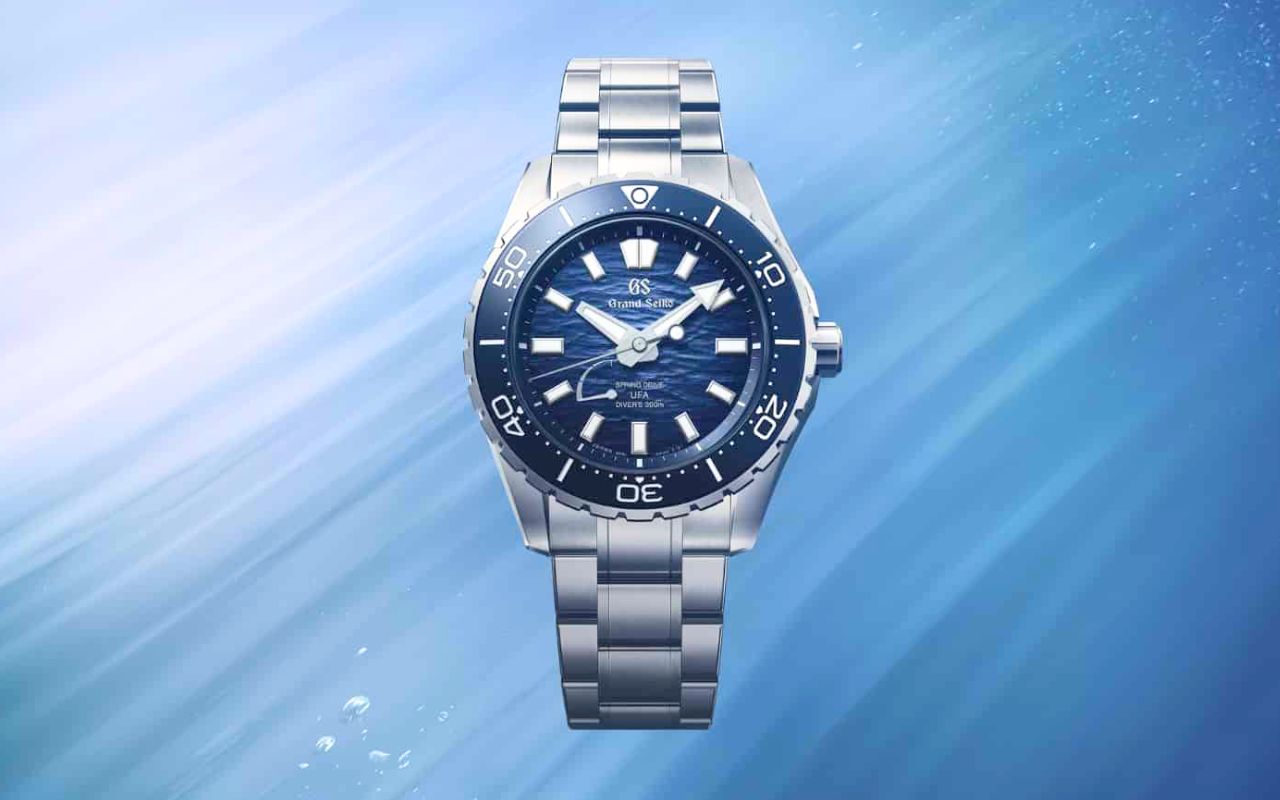
The new Grand Seiko Ushio 300 Diver lands with the kind of spec sheet that makes dive-watch fans stop scrolling, 40.8mm in diameter, 300 meters of water resistance, and a Spring Drive movement rated to 20 seconds per year.
Grand Seiko is positioning it as a serious tool watch, not a desk diver with a rotating bezel for show, and it arrives in June 2026 at $12,400. What matters is the mix: compact proportions in a category that’s been drifting bigger, a lightweight High-Intensity Titanium case, and a dial that leans into brand identity without sacrificing legibility. If you’ve been waiting for Grand Seiko to make a diver that looks and wears like the mainstream icons, but still feels unmistakably Japanese in finish and texture, this is the release aimed straight at you.

Grand Seiko sets 40.8mm and 12.9mm as its new diver baseline
The headline change is size. At 40.8mm wide and 12.9mm thick, the Ushio 300 Diver sits in the modern sweet spot, and that’s not an accident. Grand Seiko’s prior dive offerings have often read “big” on the wrist, and not in a charming vintage way. This one is built to compete in the same physical space as the watches people actually try on in stores when they say they want a luxury diver.
In practical terms, those numbers are close to the dimensions of a modern Rolex Submariner-class profile, the kind of benchmark that drives expectations for comfort under a cuff and stability on the wrist. The point is not imitation, it’s meeting the baseline ergonomics that buyers have internalized. Grand Seiko is effectively admitting that a great dial and movement do not fully compensate for a case that feels oversized for daily wear.
The case material is equally strategic. Using High-Intensity Titanium, described as about 30% stronger than steel while staying lustrous, Grand Seiko is chasing durability and comfort at the same time. Titanium’s corrosion resistance also fits the ocean theme for a true diver, not just a watch that looks nautical. The brand’s finishing reputation means titanium here is meant to look premium, not dull and gray.
There is a nuance worth calling out. Titanium’s lightness can feel almost too light at first, especially if you associate “luxury” with heft. Some buyers still equate weight with value, and that bias is real in watch retail. Grand Seiko is betting that the tactile payoff comes from the case geometry, the crispness of the surfaces, and the way the watch sits, not from making your wrist feel like it’s wearing a small dumbbell.

The Ushio gradient dial and no-date layout prioritize underwater legibility
Grand Seiko leans hard into the sea inspiration, but keeps it functional. The dial uses a tide, or “ushio,” wave texture under a gradient blue dial treatment that shifts from brighter at the center to darker at the edges. That gradient isn’t just mood lighting for collectors, it creates contrast where it matters, against the applied markers and the tips of the hands, which is exactly what you want when visibility drops.
The details are built around readability. You get diamond-cut rectangular indexes and broad hour and minute hands, plus lume on the hands and indices for low light conditions. If you’ve ever tried to read a glossy dress watch near water at dusk, you already know why this matters. Grand Seiko is clearly treating this as a real diver, not a textured-dial art piece that happens to have a timing bezel.
The decision to go no-date is a tell. On paper, a date is convenient. Under dive-watch standards, a no-date layout can be the cleaner solution because it keeps luminous markers all around the dial, supporting the kind of consistent at-a-glance reading that dive watches are expected to deliver. It also keeps the design symmetrical, which collectors tend to reward, especially when the dial already has a strong texture and gradient effect.
Up top, the watch uses a 120-click unidirectional bezel with a ceramic insert and a fully graduated 60-minute countdown track, plus a lume pip. Ceramic is the modern default for scratch resistance and color stability, and it matches the idea of a watch that’s meant to be used. The bezel’s job is simple, give you a precise, tactile timer you can’t accidentally rotate the wrong way, and the Ushio 300 Diver sticks to that playbook.
Spring Drive Caliber 9RB1 brings 20 seconds per year to a dive watch
The movement is where Grand Seiko swings hardest. Inside is the Spring Drive Caliber 9RB1, carrying the brand’s U. F. A. designation and rated to 20 seconds per year. That’s not “per day,” not “per month,” per year. In a world where many luxury mechanical divers are celebrated for being within a few seconds a day, this is Grand Seiko planting a flag for a different kind of precision.
Grand Seiko attributes that accuracy to a vacuum-sealed oscillator and a thermo-compensated integrated circuit, paired with an efficient winding system. The watch also offers a three-day, or 72-hour, power reserve, which is the practical threshold where you can put it down for a weekend and pick it up Monday without resetting. For a daily-wear diver, that convenience matters more than most enthusiasts admit.
There’s also an after-sales angle. The movement includes a regulation switch that can be used during service to correct accuracy deviations that may appear over long periods. That’s not the kind of spec that sells watches on a billboard, but it’s the kind of detail that affects ownership five or ten years in. A watch positioned as a serious tool should be designed with long-term maintenance reality in mind.
Now for the critique, because no movement spec is a free lunch. Spring Drive is not a conventional mechanical escapement, and some collectors still argue about where it “belongs” emotionally, even if they respect it technically. If your idea of romance is purely gears and an escapement ticking away, you may not connect with a system that blends mechanical energy with electronic regulation. Grand Seiko is betting that performance and smooth operation win that argument on the wrist.
Evolution 9 ergonomics and a micro-adjust clasp target real-world comfort
Grand Seiko places the Ushio 300 Diver within its Evolution 9 design language, and that matters because it signals an emphasis on wearability, not only visual identity. The case shape and ergonomics are meant to balance a tool-watch stance with comfort across a full day. If you’re wearing a diver as an everyday watch, the difference between “looks great” and “feels great at 6 p. m.” is the difference between keeping it and flipping it.
The bracelet and clasp are built to support that. The watch includes a newly developed extension clasp with micro-adjustment, and the system is designed to be versatile whether you’re on land or in the water. In addition to a 6mm three-step micro-adjuster, there’s an 18mm extender intended for use with a wetsuit. That’s a concrete nod to actual diving use, not just lifestyle marketing.
Micro-adjust is one of those features that sounds minor until you live with it. Wrists swell with heat, activity, and travel, and a fixed bracelet can go from perfect to annoying in hours. A built-in adjustment range lets you fine-tune fit without tools, which is especially relevant on a titanium watch that’s meant to be worn snug for stability but not tight enough to leave marks.
The locking mechanism is also presented as suited to diving and strenuous activity, which is the kind of unglamorous engineering that keeps a watch on your wrist when it matters. Still, the question buyers will ask is whether the clasp feels as refined as the price suggests. At $12,400, expectations are high, and the market is full of competitors with excellent clasps. Grand Seiko has to deliver tactile quality, not just a list of features.
June 2026 availability and $12,400 pricing place it against Rolex and Omega
The Ushio 300 Diver is set for availability in June 2026 with a price of $12,400. That number is not casual, it places the watch directly in the arena where buyers cross-shop icons. Grand Seiko is effectively saying this diver belongs in the same conversation as the established luxury standards, and it’s backing that claim with materials, finishing, and a movement proposition that most rivals cannot mirror directly.
Competition at this level is not just about water resistance. A 300-meter rating is table stakes in the segment, and many buyers will never test anything beyond a pool. The differentiator becomes the full package, case size that wears right, a bezel that feels precise, lume that’s actually useful, and a movement story that stands up to scrutiny. Grand Seiko’s angle is clear, make the most accurate mainspring-powered movement in its lineup the center of the pitch.
The design options also matter for market reach. The Ushio 300 Diver debuts in blue and green dial options, with the SLGB023 tied to the blue gradient look. Colorways can sound like a superficial point, but they influence whether a watch reads sporty, versatile, or niche. A blue diver is the safe, broadly appealing choice, while green can feel more fashion-forward, and Grand Seiko is covering both lanes without changing the underlying tool-watch spec.
One more nuance, availability and distribution shape perception. A watch sold through official boutique channels can feel more controlled and premium, but it can also limit casual exposure compared with mass retail presence. If Grand Seiko wants this to be the diver people try on next to the usual suspects, it needs to be physically accessible. The product is strong on paper, the next test is whether it becomes a common wrist sighting or stays a connoisseur’s pick.
To remember
- The Ushio 300 Diver SLGB023 uses a 40.8mm High-Intensity Titanium case rated to 300 meters.
- Grand Seiko’s Spring Drive UFA Caliber 9RB1 is rated to ±20 seconds per year with a 72-hour power reserve.
- A no-date dial, strong lume, and a 120-click ceramic bezel focus on true dive-watch legibility.
- The clasp adds real usability with a 6mm micro-adjust system plus an 18mm wetsuit extender.
- At $12,400 and June 2026 availability, it competes directly with top-tier luxury divers.
FAQ
- What is the Grand Seiko Ushio 300 Diver SLGB023?
- It is a 40.8mm titanium luxury dive watch in Grand Seiko’s Evolution 9 lineup, water-resistant to 300 meters, featuring a blue gradient “Ushio” wave-textured dial and a unidirectional ceramic bezel. It is scheduled for availability in June 2026 with a listed price of $12,400.
- How accurate is the Spring Drive UFA movement in the Ushio 300 Diver?
- The watch uses the Spring Drive Caliber 9RB1 with a U.F.A. designation and an accuracy rating of ±20 seconds per year. It also offers a three-day, 72-hour power reserve.
- Does the Ushio 300 Diver have a date window?
- No. The Ushio 300 Diver uses a no-date display, a choice that supports a fully marked, lume-equipped dial layout and a more symmetrical design while aligning with diver-watch legibility priorities.
- Is the bracelet designed for wetsuit use?
- Yes. The clasp system includes a micro-adjust feature and an 18mm extender intended for wear over a wetsuit, in addition to a 6mm three-step micro-adjuster for everyday fit changes.
- What are the main alternatives buyers might compare it with?
- Grand Seiko is targeting the classic luxury diver market, where watches like the Rolex Submariner and Omega’s Seamaster-class divers are common reference points. The Ushio’s differentiator is pairing that mainstream sizing with a Spring Drive UFA accuracy claim.
Sources
- Grand Seiko Spring Drive UFA Ushio 300 Diver SLGB023 Watch – Grand Seiko Official Boutique
- Grand Seiko’s Newest Diver Is Just the Right Size
- In-Depth: Grand Seiko Spring Drive UFA Ushio 300 Diver, GS’ Smallest and Most Accurate Dive Watch
- Grand Seiko Finally Drops the Dive Watch Fans Have Been Waiting For | Gear Patrol
- Watches & Wonders: Grand Seiko Finally Gives Us a Medium Sized Dive Watch, and it Includes a Spring Drive Powered U.F.A. Movement – Worn & Wound
