

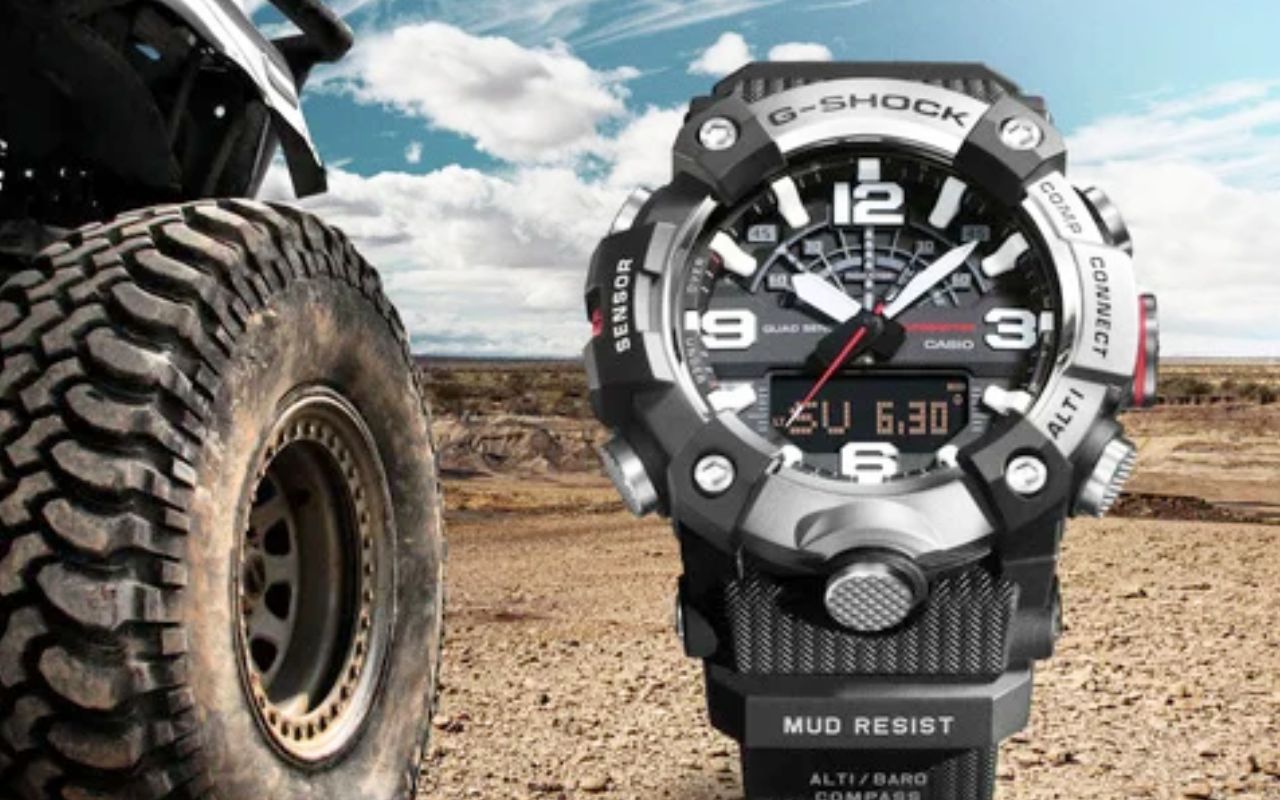
Casio’s G-Shock Mudmaster line is leaning into eco-materials without changing the core pitch: a watch built for dirty, wet, high-impact use.
The current Mudmaster variants highlight a mix of rugged construction and more sustainable components, including a bio-based resin band and parts of the case architecture designed to take abuse in the field. One model sold in Europe, the GG-B100X-1AER, puts the idea into a single spec sheet: a carbon-reinforced resin case, a bio-based plastic bracelet, and 20 ATM water resistance, a rating typically associated with serious water exposure. The question for buyers is simple: does the greener material choice change anything you’ll feel on the wrist, or is it mainly a materials story?

GG-B100X-1AER brings bio-based resin into a 51.3 mm Mudmaster build
The GG-B100X-1AER is not subtle. Its 51.3 mm case diameter and 19.4 mm thickness put it firmly in “tool watch” territory, the kind of footprint you notice when you grab a trekking pole or strap on a backpack. Casio pairs that scale with a carbon-reinforced resin case and a mineral crystal, aiming at shock and scratch realities rather than dress-watch finesse.
The eco angle is specific, not vague marketing. The bracelet is listed as bio-based plastic, and the same material shows up on the case back and bezel on this configuration. For an outdoors watch, that matters in the most practical way: the band is the part that gets sweat, sunscreen, grit, and repeated flexing. If you’re the type who rinses gear under a faucet after a muddy weekend, that’s where you’ll watch long-term wear first.
Fit and hardware details also point to real-world use. The band is sized for wrists roughly 160-230 mm, with a standard buckle and a wide stance that matches the oversized case. A retailer listing puts the price at 399 and notes a two-year warranty. That price places it in the same conversation as midrange outdoor watches, where buyers expect durability and clear functionality, not luxury finishing.
Casio rates Mudmaster at 20 ATM, and that changes how people use it
20 ATM, also shown as 20 bar, is the kind of rating that encourages owners to stop babying their watch. It signals suitability for diving-level water exposure in everyday terms, and it’s a practical promise for people who move between rain, river crossings, and water sports without swapping gear. For Mudmaster, it reinforces the “don’t think about it” identity that made G-Shock famous.
Casio also frames Mudmaster as a field watch concept, built to withstand harsh environments and aimed at keeping users informed off-trail. That positioning fits the Mudmaster family’s reputation for being worn by hikers, mechanics, and anyone who expects a watch to survive drops onto rock or concrete. The “mud” angle isn’t just a nickname, it’s a use case: grime, sludge, and messy jobs where buttons and seals get challenged.
Still, there’s a nuance worth saying out loud. Big, sensor-forward, outdoors watches can be overkill if your “trail” is mostly city sidewalks. A 51 mm case can snag cuffs and feel top-heavy on smaller wrists, and mineral crystal, while tough, isn’t the same scratch profile as sapphire in daily office wear. Mudmaster is built for abuse, but that doesn’t mean it’s the most comfortable choice for every day.
Casio’s bio-based resin strategy uses castor and corn, but expectations should stay realistic
Casio describes its bio-based resin as a polymer made from renewable organic resources, and it points to materials extracted from castor seeds and corn. The company’s sustainability claim is cautious and targeted: biomass plastics can help reduce environmental impact by curbing CO2 emissions. That language matters because it avoids promising a miracle, it’s about direction and material sourcing.
It’s also not limited to Mudmaster as a one-off experiment. Casio highlights bio-based resin use in its G-SHOCK MOVE lineup, including parts like the case, case back, and soft urethane band on certain models. In other words, the brand is building a materials playbook across categories, then applying it where it makes sense, especially on components like bands and exterior resin parts that can be swapped into existing manufacturing.
But don’t confuse bio-based with biodegradable, and don’t assume the whole watch is suddenly “green.” A Mudmaster still relies on a complex supply chain, multiple materials, and electronics, and the environmental impact depends on more than the band composition. The more concrete upside for buyers may be longevity: if a watch lasts years of hard use, fewer replacements get bought. That’s not a slogan, it’s the most measurable sustainability factor many consumers can control.
To remember
- The GG-B100X-1AER pairs a carbon-reinforced resin case with bio-based plastic parts and band.
- Mudmaster models highlight 20 ATM water resistance for heavy water exposure and outdoor cleaning.
- Casio’s bio-based resin is sourced from renewable inputs like castor seeds and corn.
- Bio-based components don’t make the entire watch “green,” but they signal a materials shift.
Q&A
- What does 20 ATM water resistance mean for a Mudmaster in real life?
- A 20 ATM (20 bar) rating is intended for high water exposure, including activities commonly associated with diving-rated watches. In everyday terms, it supports heavy rain, water sports, and routine rinsing after mud or saltwater, as long as the watch is used as intended and seals are maintained.
- Which parts of the GG-B100X-1AER use bio-based materials?
- On the GG-B100X-1AER configuration, the bracelet is listed as bio-based plastic, and the same material is used for the case back and bezel. The main case is described as carbon-reinforced resin, focusing on impact resistance for outdoor use.
- Is Casio’s bio-based resin the same thing as biodegradable plastic?
- No. Bio-based resin refers to plastics made from renewable organic resources, such as plant-derived inputs. That does not automatically mean the material is biodegradable. Casio positions it as a way to help reduce environmental impact, not as a material that disappears after disposal.
- How large is the Mudmaster GG-B100X-1AER on the wrist?
- It’s a very large watch by typical standards. The listed case diameter is 51.3 mm and thickness is 19.4 mm, with a band sized for wrists roughly 160–230 mm. That size can be a benefit for glove use and readability, but it may feel bulky for smaller wrists.
