

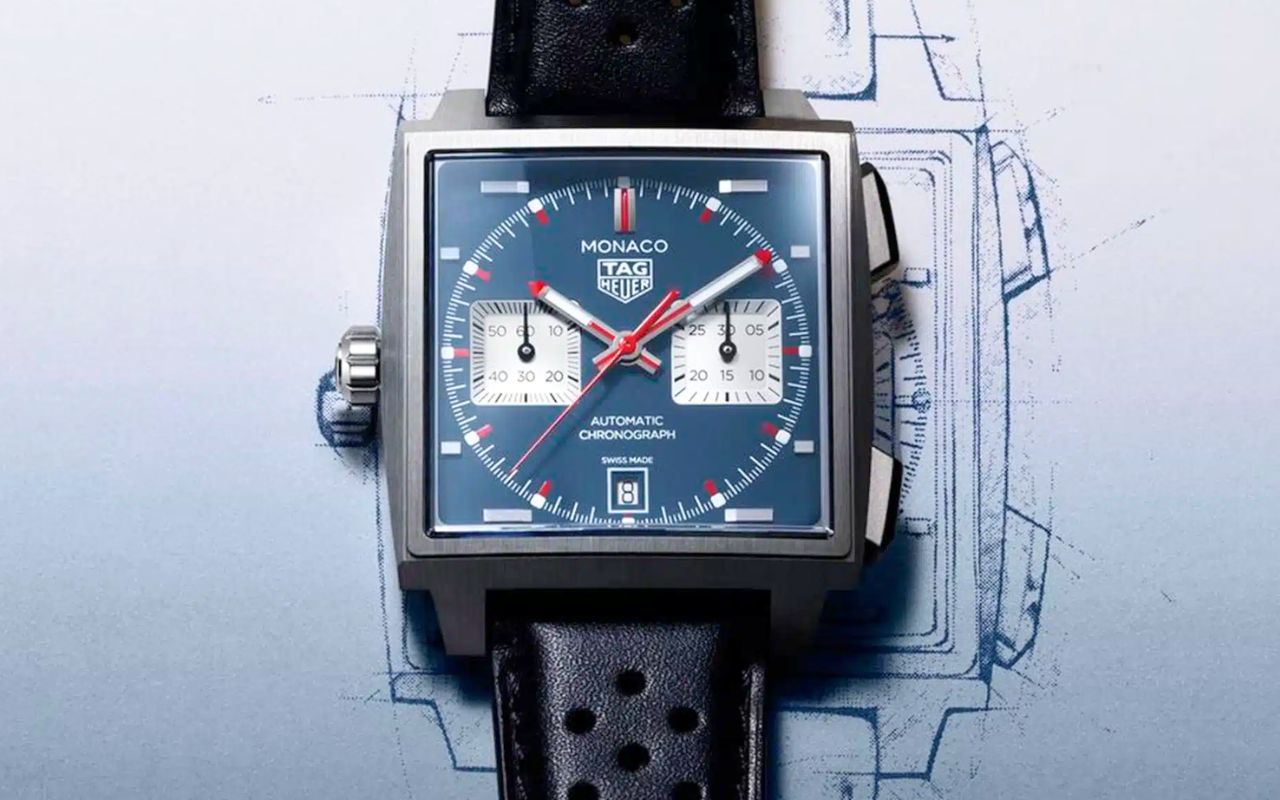
TAG Heuer unveiled at Watches & Wonders 2026 in Geneva a new generation of the Monaco Chronograph 2026, combining a return to historical design codes with more modern technical choices.
The brand highlights a Grade 5 titanium case on production models, an evolution of its in-house TH20-11 movement with an 80-hour power reserve, and a more experimental version called the Monaco Evergraph, built around a compliant chronograph mechanism based on controlled flexibility rather than traditional articulated components. Entry prices start at $9,350 for titanium versions, while a two-tone titanium and rose gold execution is positioned at $13,050. Beyond the showcase effect of the exhibition, these figures clearly signal TAG Heuer’s ambition to elevate the Monaco into a more premium segment, without abandoning the motorsport DNA that has defined the model since the late 1960s.
TAG Heuer brings back the 39 mm Monaco in Grade 5 titanium
The most immediate update comes from the case. TAG Heuer introduces production Monaco models in Grade 5 titanium, a material known for its balance of strength, lightness, and corrosion resistance. On a shaped watch, wrist feel matters as much as specifications. Titanium reduces perceived weight and changes the balance on the strap, a key factor for enthusiasts of angular chronograph cases. The brand retains the iconic 39 mm size, now a defining feature of the modern Monaco, while refining sharper edges inspired by vintage references.
TAG Heuer claims a direct link to the spirit of early Monaco models, particularly through the crystal geometry and dial layout. The sapphire crystal is described as more square in appearance, altering how light interacts with the edges, a subtle detail that often defines how a Monaco is perceived. At a show like Watches & Wonders, where comparisons happen quickly, these case and crystal adjustments help distinguish a new iteration without requiring close inspection.
The brand maintains a 100-meter water resistance rating, a notable figure for a square chronograph watch. Historically, the Monaco already stood out in 1969 by combining a square case with water resistance, a technical achievement at the time. In 2026, the challenge is different. It is about preserving everyday usability without compromising design. For customers who wear their watch while traveling, in the rain, or on weekends, 100 meters remains a meaningful benchmark.
Grade 5 titanium also signals positioning. In today’s market, sporty chronographs alternate between steel, ceramic, carbon, and titanium, each reflecting different price levels. TAG Heuer opts for a material associated with precision engineering and motorsport, while allowing clear brushed and polished finishes. On a Monaco, the interplay of surfaces on the flanks, bevels, and edges becomes a key selling point, as the square case makes imperfections more visible than on a round watch.

The TH20-11 caliber delivers 80 hours and a left-side crown
At the heart of the Monaco Chronograph 2026, TAG Heuer introduces the TH20-11 caliber, presented as an evolution of the TH20-00 launched in 2023. The brand’s message is clear. Continuity of a modern in-house movement, combined with targeted adjustments to fit the Monaco identity. The movement offers an 80-hour power reserve, addressing a practical need. Leaving the watch aside for a full weekend and finding it still running on Monday.
The use of a column wheel architecture places the watch in the expected category for a modern chronograph at this price level. For users, this mainly translates into a smoother and more precise feel when operating the pushers, although it is not the sole indicator of overall quality. TAG Heuer pairs the movement with a five-year warranty, a reassuring element at a time when servicing costs for automatic chronographs can influence buying decisions.
The most symbolic detail remains the left-side crown. On the original Monaco, this layout was linked to the Calibre 11 construction and became a visual signature. Keeping it in 2026 is more than a tribute. It is an instantly recognizable marker, visible from a distance, that sets the Monaco apart both in showcases and on the wrist. For a model balancing heritage and modernity, this kind of design cue is often more effective than any historical narrative.
From a pricing perspective, TAG Heuer sets a starting point at $9,350 for titanium models. This places the Monaco among premium sport chronographs, where comparisons focus on perceived case quality, movement consistency, dial finishing, and overall coherence. The two-tone titanium and rose gold version at $13,050 targets buyers seeking a more refined and contrasting look without moving into full precious metal territory. The price gap also creates internal segmentation with the same technical base.

The Monaco Evergraph introduces a compliant chronograph
Alongside standard models, TAG Heuer showcases the Monaco Evergraph with its compliant chronograph mechanism. In engineering terms, this approach relies on controlled flexibility within components rather than traditional articulated assemblies to transmit motion or absorb variations. In a chronograph, where engagement, activation, and reset involve multiple parts, this concept aims to reduce friction and mechanical play while improving repeatability.
For the broader audience, the benefit is not the technical term itself but the promise behind it. A chronograph that operates more consistently over time, with potentially smoother activation. Mechanical chronographs are sensitive to wear, shocks, lubrication, and adjustment. A compliant design may, in theory, reduce friction points and long-term drift. Real-world validation will depend on watchmakers’ feedback and long-term testing, but TAG Heuer’s approach signals a visible push toward mechanical innovation.
This initiative reflects a wider industry trend. Brands are exploring alternative solutions such as vertical clutches, high-frequency systems, composite materials, and now flexible micro-mechanical components. TAG Heuer uses the Monaco as a demonstration platform, which is significant. The Monaco is both an icon and an experimental field since its revival in the late 1990s, with numerous variations in dials, materials, and movements. The Geneva show becomes a stage to legitimize innovation through an established symbol.
Industrialization remains a key question. An innovation may impress in prototype form, but scaling production requires strict tolerances, controlled assembly processes, and reliable after-sales service. TAG Heuer is not expected to convert the entire Monaco range into Evergraph overnight. The goal is to signal a technical direction and reinforce the idea that the brand approaches the chronograph as an engineering object, not just a heritage product. For a brand rooted in motorsport, this performance-driven logic is consistent.
Watches & Wonders 2026 intensifies the sport chronograph competition
The presentation at Watches & Wonders 2026 is more than a backdrop. The event has become a strategic stage where brands refine their positioning in front of retailers, media, and collectors. In this context, TAG Heuer adopts a clear strategy. A Monaco closer to historical proportions, a premium material with Grade 5 titanium, and a recognizable in-house movement, the TH20-11. This combination aims to meet two expectations. Watchmaking legitimacy and immediate desirability.
The sport chronograph market is highly segmented. Entry-level steel models on one side, high-end precious metal pieces on the other. The starting price of $9,350 places TAG Heuer in a competitive zone where buyers also consider prestigious Swiss alternatives. Perceived value must be supported by tangible elements such as power reserve, warranty, finishing quality, and design coherence. Maintaining 100 meters of water resistance reinforces this usability-focused positioning.
The Monaco carries a strong cultural identity, tied to its 1969 launch and its association with Steve McQueen in the film Le Mans. While this reference remains widely used, it is no longer sufficient on its own to justify a premium positioning. TAG Heuer appears to recognize this, emphasizing modern technical arguments such as an in-house movement, column wheel, extended power reserve, and the experimental Evergraph concept. The narrative shifts from nostalgia to product-driven storytelling.
For retailers, a production titanium Monaco is also easier to sell. The benefits of lightness and durability are immediately noticeable on the wrist. Trying on a watch remains the decisive moment. Titanium can surprise customers accustomed to associating weight with quality. The sales approach then shifts toward explaining finishing, material value, technical content, and movement performance. TAG Heuer provides clear arguments. 80-hour power reserve, five-year warranty, and a strong visual identity.
A 1969 design adapted to 2026 expectations
The Monaco was originally a disruptive watch. A square waterproof case, an early automatic chronograph, and a bold aesthetic that broke away from traditional round watches. In 2026, TAG Heuer faces a delicate balance. Preserving the recognizable silhouette while avoiding repetition. Sharper lines and a more squared crystal appearance suggest a return to first-generation spirit, combined with modern standards of durability and comfort.
Consistency is also visible in how the brand connects tradition and innovation. The left-side crown remains a historical symbol but also serves as an immediate differentiator. The TH20-11 movement is presented as an evolution rather than a complete overhaul, reinforcing confidence in industrial maturity. In watchmaking, overly radical changes can raise concerns among buyers wary of early production runs. TAG Heuer seeks balance. Modernizing without compromising reliability.
Material choice plays a key role in this update. Grade 5 titanium is now a premium standard, but it remains distinctive on an iconic shaped watch because it changes perception. On a Monaco, reflections on edges, brushed and polished contrasts, and tactile feel are critical. Titanium can also better support daily wear by reducing visible marks depending on finishing. For customers associating Monaco with motorsport, this choice strengthens coherence.
Finally, TAG Heuer positions the Monaco as a bridge between two audiences. On one side, watch enthusiasts drawn to history, particularly the 1969 heritage and cultural impact. On the other, newer buyers looking for a modern, technical, and status-driven watch with an 80-hour power reserve and extended warranty. The Monaco Chronograph 2026 sits at this intersection, offering a range from core titanium models to the more experimental Evergraph execution.
