

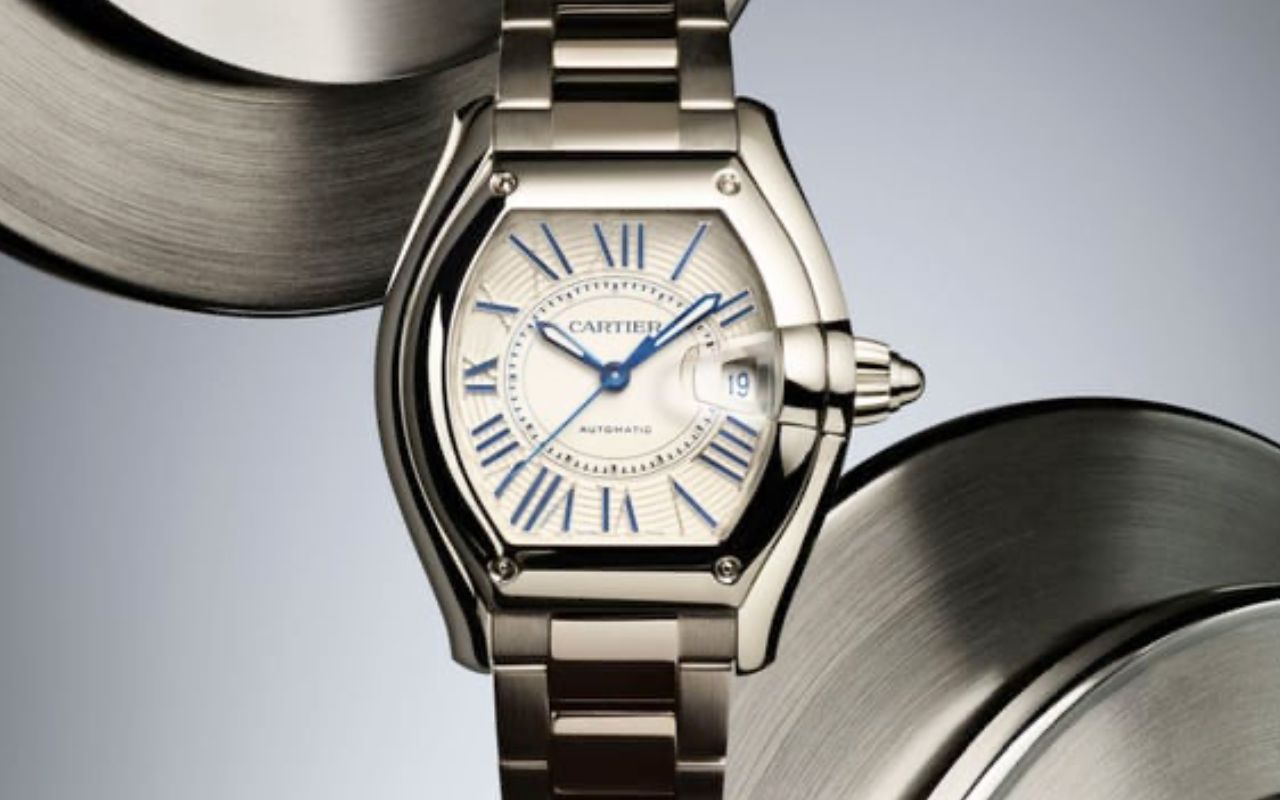
Cartier brings the Roadster back into the spotlight in 2026, with a standout presentation at Watches & Wonders 2026.
The maison revives a watch with a strong automotive character, originally launched in the early 2000s and later discontinued for several years, by reworking its proportions, finishes, and material choices. The collection returns in steel, gold, and two-tone, in two sizes, with distinct automatic movements depending on the reference. Behind this comeback, Cartier highlights the coordinated work of more than 100 artisans, a statement aimed at reinforcing credibility, balancing fidelity to the original design codes with adaptation to current market expectations.

Cartier unveils the Roadster 2026 at Watches & Wonders
The return of the Roadster comes at a strategic moment. Watches & Wonders gathers strong media and commercial attention each year, with announcements capable of shaping seasonal trends. For Cartier, bringing back a shaped watch that is instantly recognizable means reinforcing a historic territory, shaped cases, in a segment where competitors are multiplying more conventional sport-chic designs.
The Roadster holds a unique place in Cartier’s catalog. Introduced in 2002, it carried a bold visual language inspired by automotive design, with a curved case, a prominent crown, and a dial reminiscent of a dashboard. This personality appealed to a specific audience, but it also made the model feel dated when the market shifted toward more minimal designs. Relaunching it in 2026 reflects a different perspective. Distinctiveness becomes an advantage again, provided proportions and details are carefully controlled.
Cartier explains that more than 100 artisans were involved in refining the original codes into a more streamlined execution. In the maison’s vocabulary, this typically means better integration of functional elements, sharper transitions between polished and satin finishes, and refined proportions that avoid the bulky feel of some early 2000s shaped watches. For a model like the Roadster, the challenge lies in maintaining the tension of its curves without crossing into excess.
This comeback also takes place in a context where discontinued watches often gain a second life through the secondary market and the search for less common pieces. Many specialized dealers have long offered vintage Roadsters at relatively stable price levels due to limited demand. The reintroduction by Cartier changes perception. It restores contemporary legitimacy to the line and may naturally increase interest in earlier references, especially those retaining the model’s iconic features.

The 47 mm and 42.5 mm cases reshape proportions
Cartier makes a technical and aesthetic choice that stands out. The large model extends by 4 mm to reach 47 mm in length while maintaining a width of 38 mm. On a shaped watch, this adjustment is significant because wrist perception depends less on diameter and more on the relationship between length, width, and curvature. By elongating the silhouette, Cartier refines visual presence, stretches the lines, and balances the dial within the case opening.
The smaller Roadster adopts dimensions of 42.5 mm by 34.9 mm, expanding the potential audience. In contemporary watchmaking, the boundary between men’s and women’s watches is increasingly blurred for shaped designs. Length, thinness, and curvature matter as much as nominal size. With this format, Cartier can target slimmer wrists without losing the model’s identity, offering a credible option for those seeking a more restrained daily watch.
This work on proportions also responds to a common critique of earlier Roadster models, their sometimes overly thick or expressive presence, particularly in certain historical XL versions. In 2026, the stated goal is a more refined Roadster. This involves cleaner edges, smoother integration of lugs, and clearer volume definition. In practice, these updates are found in details, the angle of the bezel, the perceived height of the case flank, and the contrast between polished and brushed surfaces.
Overall coherence also depends on the dial, which must retain its dashboard-inspired identity without becoming a caricature. On original Roadsters, the automotive analogy was explicit, with indexes and typography resembling instruments. In this modernized version, Cartier preserves the structure while simplifying information hierarchy, improving legibility, and reducing outdated decorative effects. The result aims to be a watch that asserts its identity while fitting into a contemporary wardrobe, from office to weekend.
Steel, gold and two-tone expand the Roadster lineup
The 2026 collection is structured into three families, steel, gold, and steel and gold. This classic Cartier approach takes on a specific meaning for the Roadster, whose automotive DNA pairs naturally with a sportier steel execution while gaining status through gold. Steel often serves as the entry point. It supports daily wear, resists visible micro-scratches better than highly polished surfaces, and appeals to buyers seeking versatility.
The gold versions reposition the Roadster in a more jewelry-oriented segment, consistent with the maison’s identity. On a shaped watch, gold enhances the perception of curves, as light interacts differently with surfaces. This materiality can reinforce the feeling of a sculptural object on the wrist, provided the design remains controlled. In a market where gold is making a strong comeback, Cartier secures an offering aligned with both heritage and dress-oriented expectations.
The two-tone execution plays an intermediate role. Long associated with the 1980s and 1990s, it has regained momentum, particularly on watches with strong identity. On the Roadster, the combination of steel and gold can highlight structural elements such as the bezel, crown, or bracelet links. For Cartier, it also creates an instantly recognizable visual signature without fully transitioning into gold.
Beyond materials, bracelet design and ergonomics remain essential. A convincing Roadster must sit properly on the wrist, with continuity between case and bracelet and enough flexibility to follow the curvature. Enthusiasts remember earlier Roadsters for their comfort, thanks to shape and integration. In a relaunch, this becomes an immediate in-store test, as competition in the sport-chic segment is intense and first impressions often depend on how the watch fits and disappears on the wrist.

The 1857MC and 1899MC calibers structure the automatic range
Cartier pairs the two sizes with two automatic movements, the 1857MC for larger models and the 1899MC for more compact versions. This choice follows an architectural logic. The movement must match available space while maintaining consistent thickness and crown positioning. In a shaped watch, movement integration is more complex than in a round case because space distribution is uneven.
For customers, these calibers also serve as reference points. They confirm that Cartier offers a mechanical automatic proposition, expected at this price level and within a line aimed at enthusiasts sensitive to watchmaking, not just design. In today’s market, a purely design-driven relaunch would not be sufficient, as buyers compare technical specifications, reliability, serviceability, and parts availability, especially for a long-term purchase.
Precision and robustness remain practical concerns. Roadster buyers are often drawn to the idea of movement, travel, and an active lifestyle. This does not mean they expect a tool watch, but they want a movement capable of handling regular wear, temperature changes, moderate shocks, and periods of inactivity. Cartier must deliver a reassuring experience with stable regulation and predictable behavior.
After-sales service also becomes a key factor, particularly for a relaunched collection. Owners of earlier Roadsters sometimes faced challenges such as parts availability or restoration costs for polished surfaces and bracelet elements. By reintroducing the line, Cartier reactivates a network of expertise and references, which can reassure buyers. For a brand at this level, the goal is not only to launch a new model but to ensure long-term continuity with service standards aligned with its image.
The Roadster builds on automotive inspiration without collaboration
The Roadster remains one of Cartier’s watches most explicitly linked to automotive imagery. Historical descriptions often reference inspiration from the Porsche 356 of the 1950s, with a crown recalling bodywork elements and a date magnifier shaped like a headlight lens. This mechanical language resonates with an audience that appreciates technical objects, instruments, and industrial design, even within a luxury context.
In modern watchmaking, links between watches and automobiles often rely on partnerships, special editions, logos, and color codes imposed by manufacturers. Cartier takes a different path. It relies on inspiration rather than collaboration. This preserves timelessness, avoiding dependence on another brand’s image and maintaining a distinctly Cartier aesthetic. For a house built on style and coherence, this is a strategic advantage.
This approach also appeals to collectors who are wary of overly marketing-driven editions and prefer models where the story is carried by form, proportion, and execution quality. The Roadster, through its silhouette, fulfills this role. A watch recognizable at a glance, without needing explicit branding to evoke automotive design. It sits in an interesting space between sport-chic and character watch, with a strong design identity.
The key question remains market reception. Shaped watches follow cycles, alternating between periods of visibility and quieter phases compared to dominant round sport cases. By relaunching the Roadster, Cartier is betting on renewed interest in less uniform designs and on its ability to impose a strong aesthetic. The impact will be measured over time, through availability, configuration diversity, and the place the Roadster will occupy in boutiques, whether on waiting lists or in display cases depending on markets and buyer profiles.
