

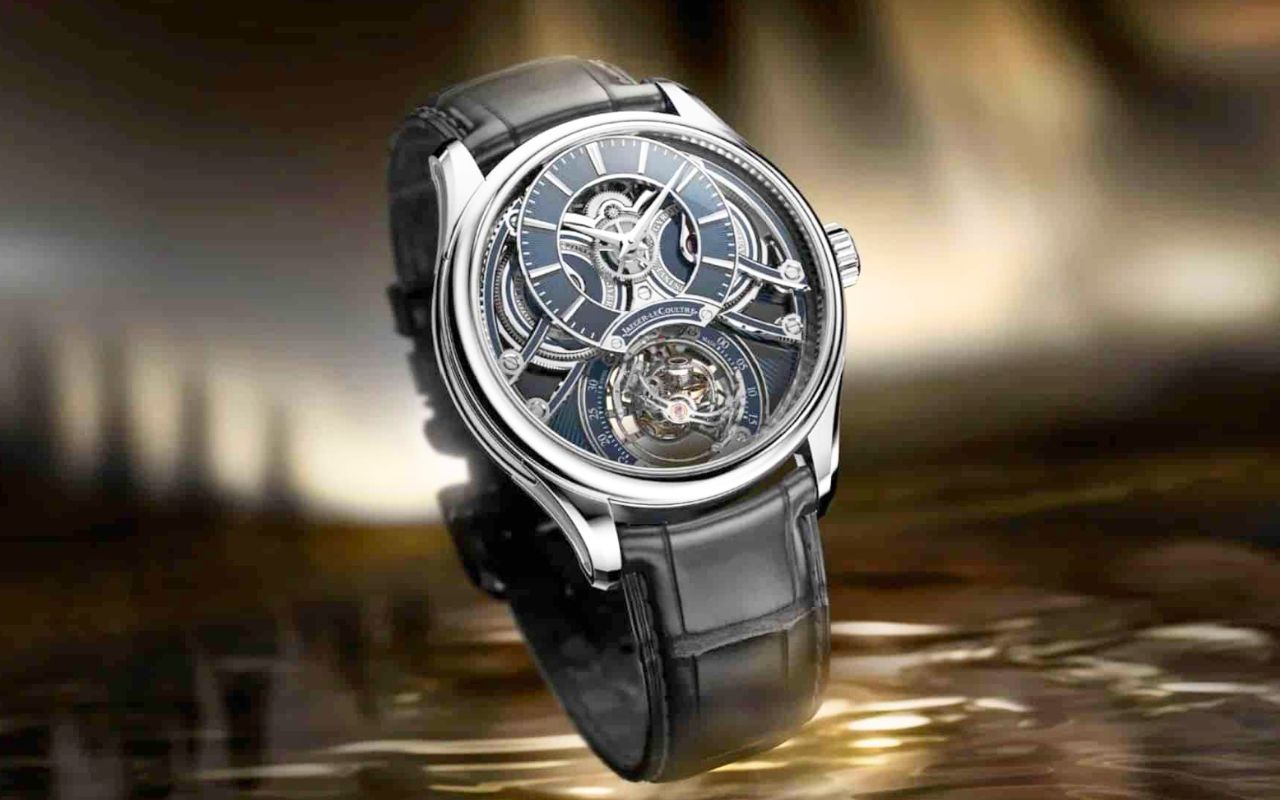
Jaeger-LeCoultre used Watches & Wonders 2026 to unveil a high watchmaking piece that concentrates part of its historical expertise, the Master Hybris Inventiva Gyrotourbillon à Stratosphère.
This release introduces the Hybris Inventiva series, designed as an experimental platform focused on a single complication pushed to its limits, rather than stacking multiple functions. The manufacture announces a triple-axis tourbillon, a 4 Hz frequency, a 72-hour power reserve, and a limited edition of 20 pieces in platinum. The name “Stratosphere” refers to a simple idea, stability. In the Earth’s stratosphere, turbulence is reduced and the air is calmer. In watchmaking, the parallel points to isochronism, the ability of a regulating organ to maintain consistent timekeeping despite positional changes. On a wristwatch, these variations remain a real challenge. The watch constantly shifts between vertical and horizontal positions, experiences acceleration, light shocks, and temperature changes. This is exactly where Jaeger-LeCoultre aims to demonstrate the technical relevance of a modern multi-axis tourbillon. At a show where announcements revolve around both innovation and rarity, the strategy is clear. With only 20 pieces, the Master Hybris Inventiva targets collectors seeking a milestone piece, a first chapter, and an instantly recognizable mechanical signature. The watch also fits into a broader narrative, that of a manufacture positioning itself as a “watchmaker of watchmakers,” highlighting its historical influence through the development of calibers and technical solutions. The launch takes place alongside other high-end creations at the show, but the Gyrotourbillon à Stratosphère stands out through its concept. It presents a watch that adds almost no additional functions to the dial, hours, minutes, seconds, while concentrating complexity within the regulating organ. This approach reflects a classic definition of high watchmaking. Difficulty is not only about multiplying indications, it is also about mastering a dynamic system in constant motion.

Jaeger-LeCoultre launches Hybris Inventiva with Caliber 178
With Hybris Inventiva, Jaeger-LeCoultre introduces a third pillar to an already structured collection. The brand has long relied on Hybris Mechanica, focused on major complications and technical architecture, and Hybris Artistica, combining complications with artistic crafts. This new branch is more focused. One horological achievement per piece, developed as a long-term prototype before being produced in very limited numbers. In practice, the Master Hybris Inventiva Gyrotourbillon à Stratosphère acts as a manifesto, defining the method rather than just presenting a novelty.
At the heart of the watch is Caliber 178, designed to drive a triple-axis tourbillon at 4 Hz, or 28,800 vibrations per hour. This frequency, common in modern automatic movements, becomes more demanding when powering multiple cages. The choice of 4 Hz aims to improve stability but requires precise control of friction, rotating masses, and energy consumption. The announced 72-hour power reserve meets collector expectations while remaining consistent with the mechanical complexity.
Jaeger-LeCoultre highlights a coverage of 98% of positions, referring to the regulator’s ability to maintain performance across a wide range of orientations. In daily use, a watch shifts between dial-up, dial-down, and vertical positions, not to mention wrist movement. A traditional tourbillon mainly compensates for vertical variations, historically designed for pocket watches. Here, the ambition is to cover almost all orientations in a wristwatch context.
This approach also meets a demand in the ultra-high-end market. Demonstration. At Watches & Wonders, brands know images circulate before timing measurements. A multi-axis tourbillon is immediately recognizable. Its rotations create a mechanical spectacle, but the brand connects that spectacle to a technical message. Stability in the “stratosphere” of positions. For collectors, this creates a dual appeal, a strong visual identity and a rational watchmaking argument.
By focusing on a single complication, Jaeger-LeCoultre also differentiates itself. Many highly complicated watches rely on accumulation. Minute repeaters, perpetual calendars, chronographs. Here, the watch does not promise multiple functions. It promises an exceptional regulating organ. This positioning appeals to buyers interested in mechanical concepts rather than features alone.
The triple-axis tourbillon rotates in 20, 60 and 90 seconds
The centerpiece is described as a “tourbillon within a tourbillon within another tourbillon.” The system uses three titanium cages rotating at different speeds and angles. The inner cage rotates in 20 seconds, the middle cage in 60 seconds, and the outer cage in 90 seconds. This layered motion creates a complex kinematic system where the escapement orientation constantly changes, aiming to smooth timing deviations caused by gravity.
The use of titanium is not cosmetic. Reducing rotational mass is essential at 4 Hz, as energy consumption increases with inertia and friction. Titanium offers a rigid yet lightweight structure, but it also requires precise machining and finishing to meet high watchmaking standards. At this level, performance alone is not enough. Finishing quality is expected to be demonstrative.
Jaeger-LeCoultre claims that no other 4 Hz tourbillon covers a comparable range of positions. Without naming competitors, this positions the innovation in a landscape where multi-axis tourbillons already exist. The key lies in combining high frequency, triple-axis architecture, and positional coverage. For observers, the balance between spectacle and performance remains critical.
In practice, the usefulness of a tourbillon is debated. A well-regulated modern watch can perform accurately without one. But high watchmaking is not only about utility. It is also about mastering extreme systems, making them reliable, and producing them in very small numbers. The triple-axis tourbillon becomes a technical culture object, a marker of expertise.
Displaying only hours, minutes, and seconds reinforces clarity. The focus remains on the moving cage. In a showroom, this type of piece has a clear role. Attract, hold attention, and convince. The tourbillon becomes a universal language, understandable even without technical knowledge.

The 42 mm platinum case frames a 72-hour power reserve
The Master Hybris Inventiva Gyrotourbillon à Stratosphère is housed in a 42 mm case with a thickness of 16.15 mm, placing it firmly in the category of large complications. The size remains wearable for some enthusiasts, but the thickness reflects mechanical reality. A multi-axis tourbillon requires volume and structural rigidity.
The use of platinum for 20 pieces reinforces exclusivity. Platinum is dense, difficult to work with, and associated with the highest segment of watchmaking. It also creates a contrast with the lightweight titanium cages. This material opposition can be seen as a balance between stability and performance.
The 72-hour power reserve represents a balanced choice. A 4 Hz frequency and multiple cages suggest high energy consumption. Achieving three days of autonomy indicates optimization in energy management and torque stability. Collectors often focus on both duration and consistency across the power reserve.
Aesthetically, the watch features symmetry and shimmering blue textures. This modern visual language avoids overly traditional decoration. The goal is to present a contemporary interpretation of a historical complication, where the mechanics remain central.
Positioning the watch within the Master collection is also meaningful. Traditionally associated with understated elegance, the Master line expands here into experimental territory. This allows Jaeger-LeCoultre to leverage an established name while introducing a technical peak.
Watches & Wonders 2026 positions Jaeger-LeCoultre against Patek and Rolex
Watches & Wonders has become a central event for Swiss watch brands. In 2026, the presence of major groups and independent brands creates an environment of constant comparison. Jaeger-LeCoultre responds with a highly distinctive piece that stands out visually and technically.
The brand also asserts authority. Compared to competitors like Patek Philippe or Rolex, Jaeger-LeCoultre focuses on complication-driven identity. The Gyrotourbillon à Stratosphère becomes a statement of technical legitimacy.
Such pieces also play a halo role. While 20 platinum watches will not drive revenue alone, they enhance overall brand perception and support the desirability of more accessible collections.
Availability becomes a key topic. A 20-piece edition implies highly controlled distribution, often reserved for top clients. This scarcity can create long-term demand and reinforce the watch’s status as a milestone.
The “stratosphere” concept also reflects a broader trend. Explaining technical innovation through accessible metaphors. This approach makes complex watchmaking easier to communicate to a wider audience.
The 20-piece limited edition targets high complication collectors
A 20-piece platinum edition positions the Master Hybris Inventiva Gyrotourbillon à Stratosphère in a very specific market. Collectors capable of acquiring and maintaining extreme complications. A multi-axis tourbillon involves tight tolerances, lightweight components, and complex adjustments. Buyers are not just purchasing a watch but entering a long-term relationship with the manufacture.
Rarity also invites comparison with other limited high-end series. Producing only 20 pieces allows for strict quality control and preserves exclusivity.
The target collector is not seeking a daily watch. Typically, they already own major complications such as minute repeaters or perpetual calendars and are now looking for a piece focused on regulation. The 98% positional coverage becomes a discussion point, a technical challenge to explore with other enthusiasts.
The watch’s value also depends on its place in the brand’s history. Jaeger-LeCoultre refers to a sixth generation of gyrotourbillons, creating continuity. Owning the first Hybris Inventiva model may become as significant as the complication itself.
Finally, usability remains a question. Highly complicated watches can end up stored if considered too fragile. The 4 Hz frequency and 72-hour power reserve suggest an effort to make the watch more wearable, at least occasionally. The simple display of hours, minutes, and seconds may also encourage more frequent use.
Q&A about the Master Hybris Inventiva Gyrotourbillon à Stratosphère
Is the Gyrotourbillon à Stratosphère entirely new at Jaeger-LeCoultre
It builds on two decades of gyrotourbillon development but introduces a sixth-generation triple-axis system and launches the Hybris Inventiva line.
What do the 20, 60 and 90 second rotations mean
They correspond to the speeds of the three cages. The inner rotates in 20 seconds, the middle in 60, and the outer in 90, constantly changing escapement orientation.
Why use a 4 Hz tourbillon
A higher frequency can improve stability against small disturbances, though it increases energy demands, hence the 72-hour power reserve.
How many pieces will be produced and in what material
The watch is limited to 20 pieces, all in platinum.
Does the watch include other complications
No. It displays hours, minutes, and seconds, concentrating complexity in the regulating organ.
