

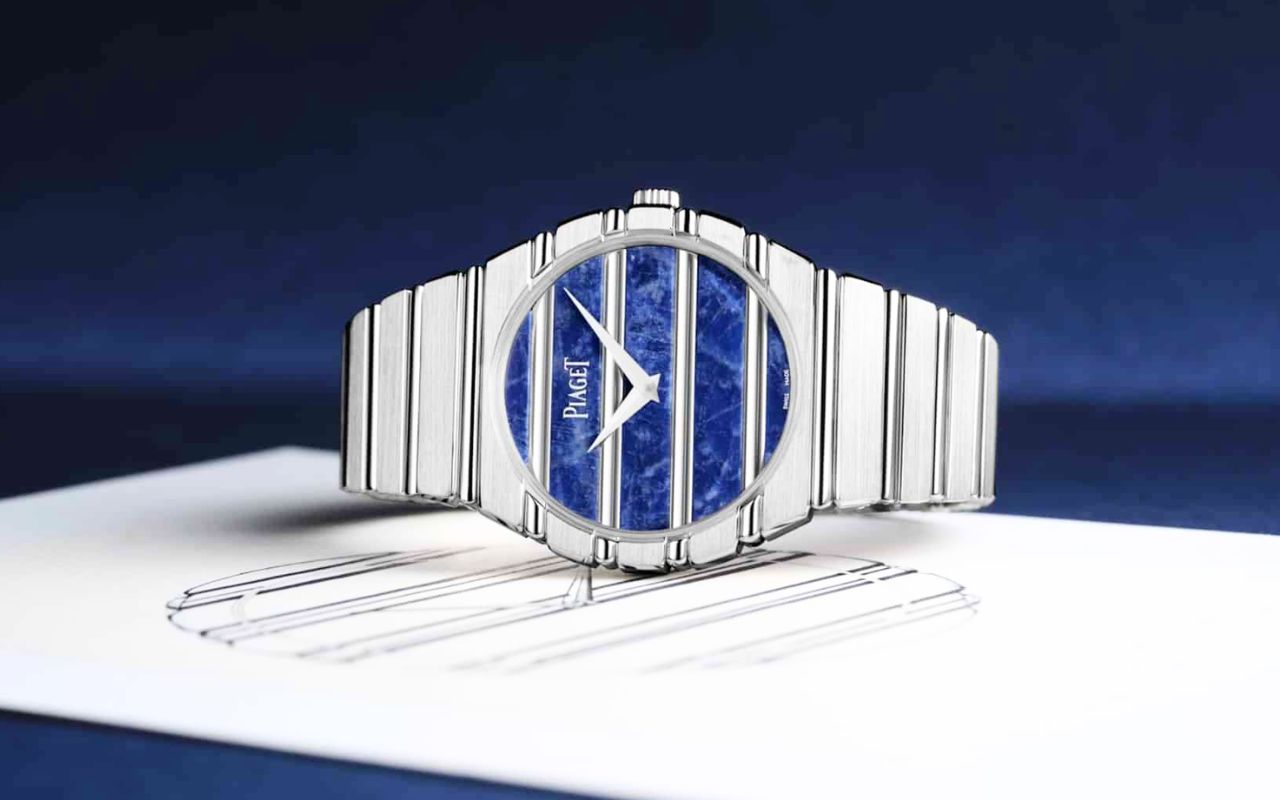
Piaget is bringing back the Polo 79 in white gold for 2026, pairing the sculptural bracelet-watch silhouette with a striking blue sodalite dial.
The release lands during the brand’s anniversary cycle and leans into a very specific Piaget signature, hardstone dials framed by precious metal architecture rather than printed textures. The headline specs are clear and very Piaget: a 38mm case, a slim 7.45mm profile, and an ultra-thin automatic caliber with a micro-rotor visible through a sapphire caseback. It’s a high-end play that’s easy to admire up close, but it also invites a practical question, how many people really want an all-white-gold integrated bracelet watch as a daily wear piece?
Piaget frames the sodalite dial inside Polo gadroons
The new dial choice is the point of impact. Sodalite is presented as a royal blue mineral with white calcite veining, and in this watch it doesn’t take over the entire face. Instead, it sits between four polished white-gold bars that cross the dial, keeping the Polo identity intact through the alternating gadroons and satin-finished elements.
That decision matters because it preserves what collectors recognize at a glance: the watch reads like a bracelet first, with the dial integrated into a continuous set of horizontal links. In person, the contrast between the cool sheen of 18K white gold and the mottled blue stone should be the kind of detail that pulls you in at arm’s length, not just in macro photography.
There is also a small but telling change versus earlier executions. This sodalite dial does not show the dotted minute track detail seen on some prior versions, which makes the face feel cleaner and more jewelry-forward. If you’re the type who wants quick, precise legibility, that’s where you might pause, the watch is clearly prioritizing surface, material, and proportion over tool-watch readability.
Caliber 1200P1 uses a 22K micro-rotor to stay ultra-thin
Flip the watch over and the technical story comes into focus. The 1200P1 automatic movement is built around an off-centered micro-rotor in 22K gold, a classic solution when a brand wants self-winding convenience without stacking height. The movement beats at 21,600 vph and is rated for a 44-hour power reserve.
Decoration is part of the pitch. The movement is described with circular Geneva stripes, beveled bridges, blued screws, and perlage, the sort of finishing vocabulary that signals “manufacture” credibility to buyers who expect more than a pretty case. A boutique advisor might tell you this is the kind of caliber that rewards slow inspection, the rotor position, the light play on anglage, the contrast of polished and matte surfaces.
Still, ultra-thin has trade-offs, and it’s fair to say it out loud. A 5 bar water-resistance rating is fine for daily life, but it’s not a sports-watch spec, even if the integrated-bracelet silhouette can suggest otherwise. If you want one watch to do everything, you may end up comparing this to steel icons, and realizing Piaget is selling a different promise: elegance, not rugged versatility.
Watches & Wonders 2026 expands Polo 79 after the 2024 yellow-gold re-edition
This white-gold model arrives after the modern relaunch of the Polo 79 concept in 2024, when Piaget revived the design in solid yellow gold and earned major industry attention, including an “Iconic watch of the year” award at the Grand Prix d’Horlogerie de Genève. For Watches & Wonders 2026, the brand is clearly extending that momentum with a cooler, more contemporary metal-and-stone pairing.
It also fits Piaget’s long-running playbook. The brand has a documented history of pushing ultra-thin calibers into jewelry territory, and hardstone dials are part of that lineage. The Polo 79 format, a watch that “features a bracelet,” is basically a platform for material experimentation, and white gold plus blue stone is an easy way to differentiate without changing the core geometry.
For buyers, the implications are straightforward. This is a statement piece in a market that’s been crowded with integrated-bracelet watches, and Piaget is trying to win through finishing and materials rather than aggressive complications. The price is listed as available upon request, and that’s a reminder of who this is for: someone shopping in boutiques, comparing precious-metal weight, dial rarity, and movement thinness, and deciding whether the bold blue sodalite is the detail that makes the watch feel personal.
À retenir
- Piaget’s 2026 Polo 79 pairs rhodium-finished white gold with a blue sodalite hardstone dial.
- The 38mm case stays slim at 7.45mm thanks to the ultra-thin 1200P1 automatic micro-rotor movement.
- Specs emphasize elegance: 21,600 vph, 44-hour power reserve, and 5 bar water resistance.
- The model extends the modern Polo 79 revival that began with the 2024 yellow-gold re-edition and major industry recognition.
Questions fréquentes
- What are the key specifications of the Piaget Polo 79 in white gold?
- The watch uses a 38mm rhodium-finished 18K white-gold case and integrated bracelet, with a slim 7.45mm thickness. It features a blue sodalite dial and a sapphire caseback, and it is rated to 5 bar water resistance.
- What movement powers the Piaget Polo 79 white-gold model?
- It is powered by Piaget’s 1200P1 self-winding manufacture movement, built with an off-centered 22K gold micro-rotor. The movement runs at 21,600 vph and offers a 44-hour power reserve.
- How is the sodalite dial integrated into the Polo 79 design?
- The blue sodalite is inserted between polished white-gold bars that traverse the dial, preserving the Polo’s signature gadroons and alternating brushed and polished surfaces rather than replacing the design with a full stone slab.
- Is the price publicly listed for the white-gold Piaget Polo 79?
- Piaget lists the price as available upon request, which typically means the exact figure is provided through boutiques or brand advisors rather than displayed as a fixed public MSRP.
