

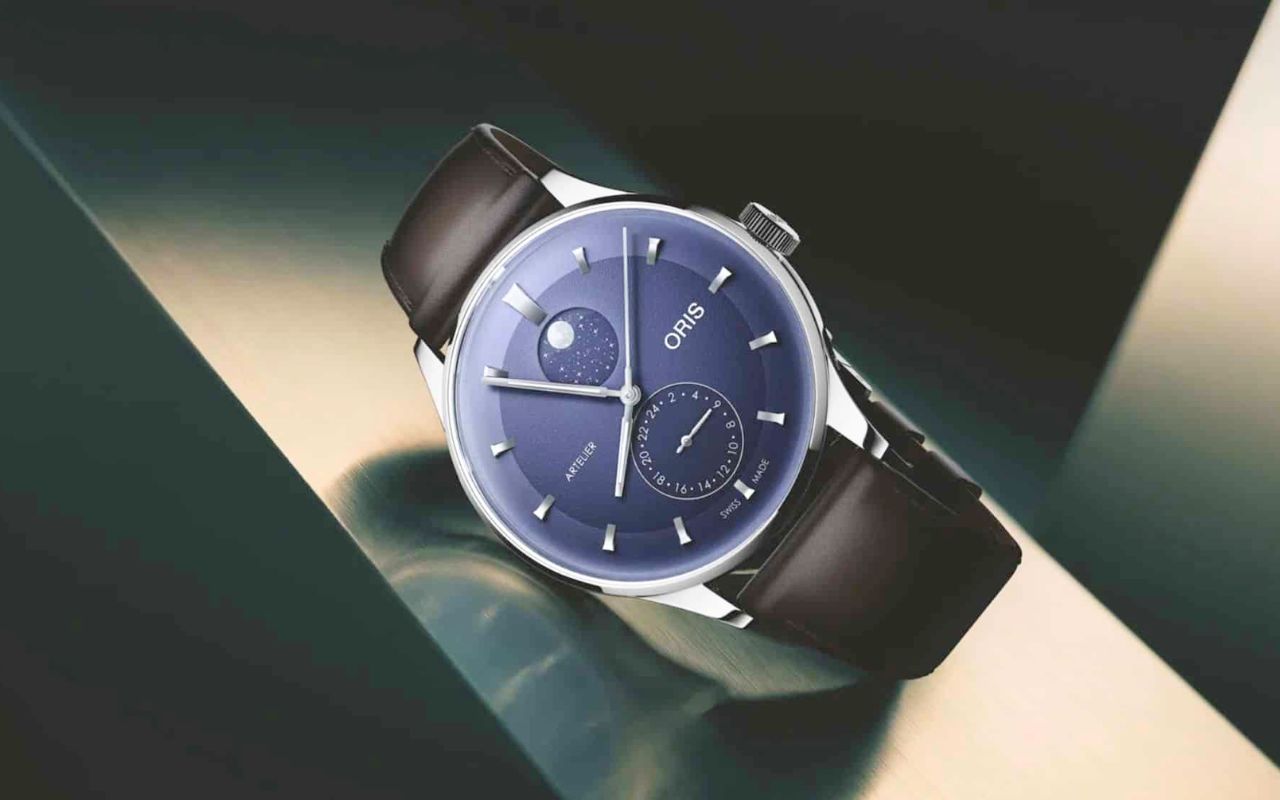
The Oris Artelier Complication 2026 is back with a clearer, more contemporary approach to classic dress-watch complications: a moonphase and a second time zone displayed on a 24-hour register.
Presented at Watches and Wonders 2026, the update keeps the Artelier’s role as Oris’ elegant counterweight to its better-known dive and pilot families, but it modernizes the look with fewer visual cues and more breathing room. Oris is also being unusually explicit about who this watch is for: the young, urban watch enthusiast who wants a mechanical piece that reads cleanly at a glance. The redesign was led by Lena Huwiler, 24, a product design engineer at Oris, and it arrives in a 39.5mm steel case with a new Calibre 782 movement. Availability is slated for May 2026, with pricing around 2,500 on bracelet or about 2,300 on strap.

Lena Huwiler cuts the dial to two subdials
The most visible change is the decision to reduce the display from four subdials to two, a move Oris positions as the core of the 2026 refresh. Prior Artelier Complication generations used multiple counters for weekday, date, moonphase, and a second time zone. In the new layout, the watch focuses on the two complications Oris calls most desirable here, the moonphase and the GMT-style second time zone, and it gives each a dedicated register.
The dial architecture reinforces that “less, but better” intent. Oris uses a three-part construction: a textured central field, a smooth outer ring, and recessed subdials. The vertical symmetry is deliberate, with the moonphase at 12 o’clock mirrored by the larger 24-hour counter at 6. If you’ve ever found multi-register dress watches busy in real life, this simplified arrangement is the practical payoff, you can read it quickly without hunting.
Design details lean modern rather than ornate. Applied hour markers are tapered and stepped, and the handset stays slim and legible. Oris also introduces a new sans-serif typeface for “Artelier” and “Swiss Made,” a small change that signals the broader shift toward an urban, contemporary graphic identity. The hour and minute hands have Super-LumiNova inserts, a nod to everyday usability rather than pure formalwear.
There is a tradeoff, and it’s worth stating plainly. Cutting two subdials means giving up some information density that older Artelier Complication owners may have enjoyed. Collectors who liked the “calendar dashboard” feel of the previous generation may see the 2026 edition as less “complicated” in spirit, even if the remaining functions are the ones many people actually use. Oris is betting that clarity will win more new wrists than maximalism.
Oris keeps a 39.5mm case and 11.8mm thickness
On paper, the case proportions look tuned for modern dress-watch wear. The stainless-steel case measures 39.5mm in diameter, 11.8mm thick, and about 45.5mm lug-to-lug. That footprint matters because it’s a meaningful shift away from the oversized dress-watch era, and it should sit more naturally on a wider range of wrists than older, larger Artelier references.
Oris mixes brushed and polished surfaces, aiming for a watch that can pass in an office but still feel current with casual clothes. The crystal is domed sapphire with anti-reflective coating, and the caseback is screwed down with a mineral-glass window. Those choices are familiar in this price segment, but they’re also the difference between a watch that looks good under boutique lighting and one that stays readable outdoors, especially on a dial with multiple textures.
The functional detail to know is the corrector for the second time zone. Oris integrates a pusher around 4:30 on the case flank to adjust the 24-hour display. The idea is to keep the crown from becoming a multi-position puzzle, and to make travel adjustments straightforward. In daily use, that could mean a quick correction after landing, without cycling through settings you don’t need.
The main critique is hard to ignore: water resistance is rated at 30 meters. For a watch described as modern and urban, that number can feel underwhelming in 2026, when many buyers expect at least “life-proof” specs. Yes, it’s a dress watch, but real life includes rain, handwashing, and the occasional sink mishap. Oris is clearly prioritizing elegance and case refinement over ruggedness, and buyers should treat it accordingly.
Calibre 782 powers moonphase and second time zone
Inside, Oris fits the new Calibre 782, which supports the simplified complication set and the single-corrector approach. The brand’s messaging around the 2026 Artelier emphasizes usability, and the movement choice aligns with that: core timekeeping, plus a moonphase display and a second time zone shown on a 24-hour register. For the target buyer, this is the “two complications you’ll actually interact with” package.
The moonphase is designed to be a focal point rather than a tiny afterthought. Visually, it features a semi-realistic moon set in a star field, and the decoration extends beyond the disc into the aperture area. That extra effort matters because moonphases can easily look generic at this price, and Oris is using artistry to justify the “complication” name even after reducing the dial furniture.
The second time zone is also presented with restraint. Rather than a fourth hand running around the dial, Oris uses a dedicated subdial at 6 o’clock with a 24-hour scale. That format won’t be everyone’s favorite, but it keeps the main dial clean and makes it obvious whether your home time is day or night. If you regularly call colleagues overseas, that day-night clarity is the part you’ll appreciate most.
Oris also centralizes adjustments through the crown or the recessed pusher, reducing the number of “how do I set this?” moments. A watchmaker in New York, Marc D., who services a lot of entry-luxury Swiss pieces, put it bluntly in conversation: “People don’t mind complications, they mind confusing controls.” The Artelier Complication 2026 seems designed to avoid that, even if purists would prefer a more traditional GMT execution.
Six versions: ivory, midnight blue, chestnut, strap or bracelet
Oris launches the Artelier Complication 2026 in six configurations built from three dial colors and two wearing options. The dial choices are ivory, midnight blue, and chestnut, each available on either a leather strap or a steel bracelet. This is a straightforward matrix, but it’s also a practical one: it lets Oris keep the message consistent while offering enough variety for different wardrobes.
The bracelet option is an H-link style in steel, and it pushes the price to about 2,500. The strap version comes in around 2,300. In this segment, that spread is typical, but it still changes the buying logic. If you’re comparing the Oris to other Swiss dress watches around the same number, the bracelet version competes more directly with “one watch for everything” buyers, while the strap version reads more like a deliberate dress choice.
Dial execution varies subtly by color. On the chestnut dial, the subdials appear in a deeper shade, adding contrast and making the registers pop. On the ivory and blue versions, the subdials are more tone-on-tone, which can look cleaner but may reduce immediate separation between surfaces. If legibility is your priority, the chestnut configuration may be the sleeper pick, even if it’s the least traditional color in the set.
Oris also keeps the bezel minimal, which gives the dial more presence than the diameter suggests. That can be a positive, you get a modern footprint without a large case, but it also means the watch will feel more “dial forward” than some classic dress pieces. If you prefer a smaller visual presence, you might want to see it in person before buying, because photos rarely capture how wide open the dial reads on wrist.
Why Oris positions Artelier as an everyday dress watch in 2026
The Artelier line has always been Oris’ reminder that the brand isn’t only about divers and pilots. In 2026, that positioning looks even more intentional: the company frames the Artelier as a quality mechanical watch for people who want a reliable daily piece without chasing status signaling or inflated price points. That’s a strong statement in a market where many releases seem engineered to climb the luxury ladder.
From a consumer angle, the 2,500 neighborhood is competitive but crowded. Buyers can find Swiss automatics with clean dials, and they can also find sport models with higher water resistance and more lume. Oris’ bet is that a well-proportioned case, a decorated moonphase, and a simple second time zone will feel more “grown up” than a spec-sheet race. That’s credible, but it’s also a narrower lane.
There’s also an interesting generational play. Oris explicitly links the redesign to a younger audience, and it assigns a face to that shift with Lena Huwiler. That can read as a marketing angle, but the design choices do support it: fewer subdials, cleaner typography, and a more architectural dial structure. If you’re used to vintage-inspired dress watches that lean nostalgic, this one is trying to look like the present.
The risk is that the Artelier Complication 2026 may feel slightly disconnected from what many people think “Oris” means, especially for buyers who associate the brand with tool-watch value and robustness. A watch can be elegant and still feel sturdy, and the 30m rating will come up in any serious conversation. If Oris wants this to be a true everyday dress watch, not just a nice office watch, the next step may be improving real-world durability without losing the refined case profile.
À retenir
- Oris refreshes the Artelier Complication for 2026 with a simplified two-subdial layout.
- The 39.5mm steel case is 11.8mm thick, with 30m water resistance and a pusher-adjusted second time zone.
- Calibre 782 supports a moonphase at 12 and a 24-hour second time zone at 6.
- Six variants combine three dial colors (ivory, midnight blue, chestnut) with strap or bracelet options, starting around €2,300.
Questions fréquentes
- When will the Oris Artelier Complication 2026 be available?
- Oris indicates availability in May 2026, following its Watches and Wonders 2026 presentation.
- What complications does the Artelier Complication 2026 include?
- It combines a moonphase display with a second time zone shown on a 24-hour subdial, keeping the dial to two registers for clearer reading.
- What are the case dimensions and water resistance?
- The stainless-steel case measures 39.5mm wide, 11.8mm thick, and about 45.5mm lug-to-lug, with a 30-meter water-resistance rating.
- How much does the Artelier Complication 2026 cost?
- Pricing is communicated around €2,500 on a steel bracelet and about €2,300 on a strap, depending on the version.
Sources
- Introducing: The Refreshed Oris Artelier Complication
- Oris at Watches and Wonders 2026: The Star is Reborn and the Artelier Complication returns – Revolution Watch
- Introducing the Oris Artelier Complication | WatchTime
- Introducing: The Oris Artelier Complication, A Dress Watch Redesigned For A New Generation – Hodinkee
- New Release: The All-New Oris Artelier Complication Watches | aBlogtoWatch
