

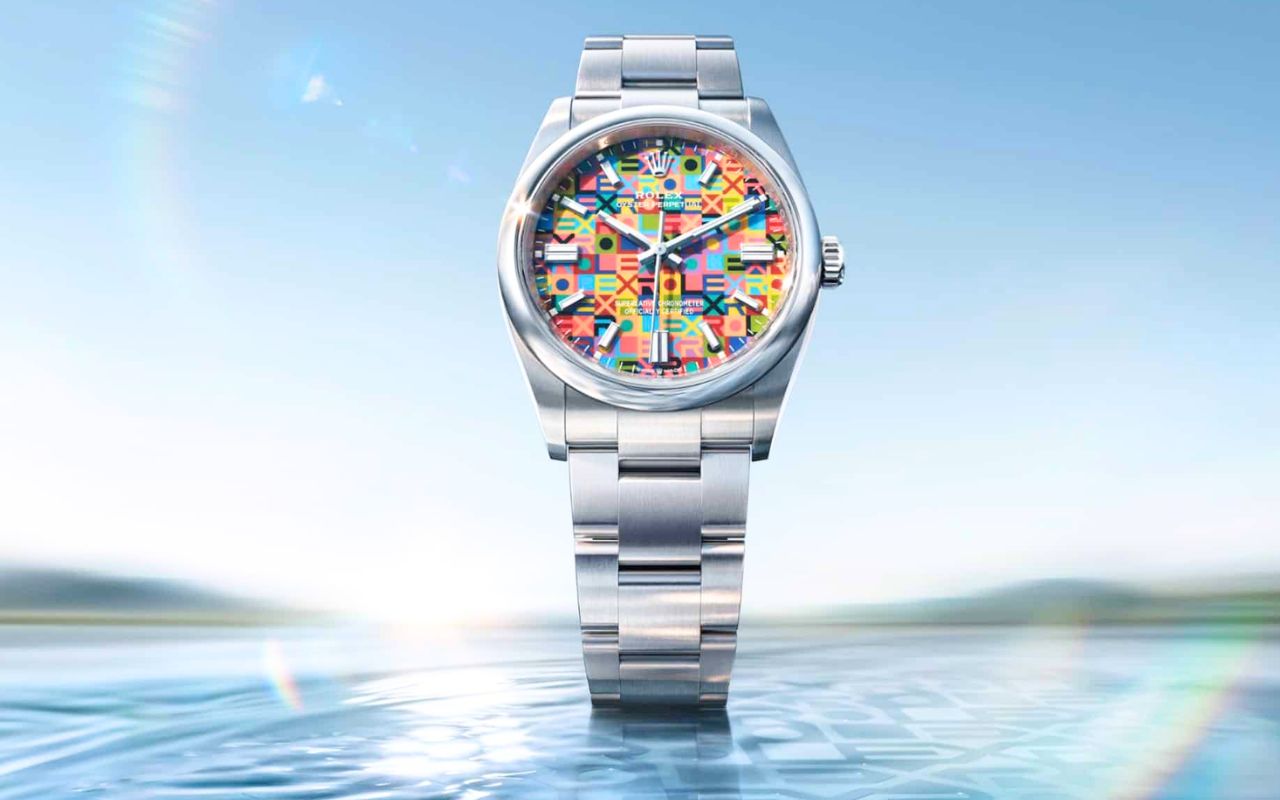
Rolex didn’t change the case shape, didn’t add a complication, and didn’t chase a new size.
For 2026, it put the provocation where the brand has been loosening its tie lately, on the dial. The Oyster Perpetual 36 “Jubilee Dial” (ref. 126000) takes a familiar Rolex graphic, repeats the brand name across the surface, and prints it in ten colors that read like pop art at arm’s length and like a manufacturing flex up close. The timing is not random. This release lands in the year Rolex marks the 100th anniversary of the Oyster case, the waterproof template that built the company’s modern identity. The result is a watch that stays mechanically conservative, with the no-date Caliber 3230, but visually refuses the usual “quiet luxury” script. If that sounds contradictory, that’s the point, and it’s why collectors can’t agree on whether it’s genius or annoying.

Rolex launches the Jubilee Dial for Oyster 100 in 2026
The Jubilee motif isn’t new, and Rolex is counting on that history to keep the watch from feeling like a stunt. The repeating “ROLEX” grid has appeared in past decades, and collectors often point to anniversary-era executions as the reference point. What changes in 2026 is the treatment: the motif becomes a colorful, lacquered statement on a watch that traditionally lives on restraint. It’s a celebration, but it’s also a test of how far the brand can push without leaving its lane.
Rolex’s own description leans on process, not hype. The brand says the colors are not applied all at once, but laid down one after another, with tight tolerances so the shapes and letters align precisely. That detail matters because it frames the dial as industrial craft rather than a fashion print. You can roll your eyes at marketing language, but the underlying idea is clear: the “fun” is backed by production discipline.
In person, the dial reads differently depending on distance and lighting. From across a room, it can look almost like a textured neutral, because the grid breaks up into a soft pattern. Up close, the ten-color palette becomes obvious, with each block of lettering popping in contrast. That split personality is part of the design’s trick: it’s loud when you invite scrutiny, quieter when you don’t, which is not how most colorful watches behave.
There’s also a strategic angle. Rolex has been expanding dial variety without leaning on limited editions or exotic case changes, and this release continues that pattern. The Jubilee Dial sits inside the core Oyster Perpetual family, not in a niche line, which gives it mainstream legitimacy. But it also sets expectations, if Rolex can do this on an entry point steel model, then the old “Rolex never experiments” argument gets harder to defend.

Caliber 3230 keeps the watch conservative under the dial
Under the color, Rolex stays firmly in its comfort zone. The Caliber 3230 is an automatic, no-date movement running at 4 Hz, built with a Chronergy escapement and a stated 70-hour power reserve. It’s the kind of spec sheet Rolex fans like because it’s predictable in the best way: robust, modern, and designed for long service intervals rather than novelty. If you wanted an open caseback or a new architecture, this is not that watch.
The movement uses 31 jewels, and the watch carries Rolex’s Superlative Chronometer designation, which combines pre-casing chronometer testing with post-casing Rolex checks. The headline accuracy claim remains the familiar -2/+2 seconds per day, a number that has become a shorthand for the brand’s performance baseline. That figure is not a guarantee of what every wrist will see, but it’s the standard Rolex wants associated with daily wear.
For 2026, Rolex also strengthens the Superlative Chronometer program with additional pillars: anti-magnetism, durability, and sustainability. The company positions these as additions to the earlier framework that already covered precision, power reserve, automatic winding, and water resistance. The language is corporate, sure, but the direction is meaningful. It signals Rolex is treating modern threats, magnetism in particular, as a mainstream expectation rather than a boutique feature.
Here’s the nuance that bugs some collectors. The Jubilee Dial looks like a new personality, but the mechanics are intentionally familiar. That can feel like a mismatch if you expect visual daring to come with technical novelty. On the other hand, Rolex is selling a daily watch, not a concept piece. The conservative movement is what lets the dial be the headline without turning the watch into a fragile “special occasion” object.
The ten-color printed motif shifts Rolex’s idea of “quiet”
The dial is the argument. Rolex repeats its own name across the surface, and it does it in ten contrasting colors, which is a pretty direct challenge to the idea that the brand’s power is all about understatement. The motif has a retro graphic vibe, often compared to 1960s pop art, and it’s intentionally different from the engraved, more formal Jubilee executions people remember from dressier references. Printing, not engraving, changes the emotional temperature.
Printing also changes how the watch plays with light. Engraved patterns catch shadows and can look “expensive” in a traditional way, because depth reads as labor. A printed dial can look flatter, and that’s where some of the debate starts. Critics argue it risks feeling like a logo wallpaper. Fans counter that the precision of aligning multiple color applications is the real craft, just expressed through registration and consistency rather than depth.
On wrist, the 36 mm format matters. A larger canvas could turn the repeating logo into a billboard. At 36 mm, the pattern stays compact, and the watch can still pass as a simple steel Rolex from a few feet away. That’s why the design unsettles established codes: it’s not a neon sports watch that announces itself immediately, it’s a conservative silhouette that reveals a playful interior only when you engage.
A retailer I spoke with, Marc, described the reaction at the counter as “two seconds of confusion, then a grin.” He said some buyers ask if it’s an aftermarket dial, which is a real-world reminder of how unusual this is for Rolex’s mainstream line. That suspicion is part of the watch’s cultural role. It forces a conversation about authenticity, taste, and what counts as “proper” Rolex, without changing the fundamentals that make the brand recognizable.
Availability stays tight even without limited-edition tactics
Rolex does not frame the Jubilee Dial as a limited edition, and it is not presented as off-catalog. Still, the market reality is that a desirable dial on a steel Rolex can be effectively scarce. The watch arrives in a climate where many buyers already expect waitlists, relationship selling, and uneven allocation across regions. That gap between official positioning and real availability is where frustration grows, especially for first-time buyers.
The Jubilee Dial also lands after several years in which colorful dials became a major storyline for Rolex, and that history changes expectations. When a brand trains the market to treat color as the “hard to get” attribute, demand concentrates fast. Even if the price is aligned with other OP36 variants, the perceived rarity of the dial can make it the one everyone asks for, which dealers have to manage with the usual, sometimes opaque, prioritization.
What does that look like in practice? Marc told me the most common question isn’t about the Caliber 3230 or the 70-hour reserve, it’s “Can you actually get it?” That’s a telling shift. The watch becomes a social object, something you wear to meets and events because it’s recognizable to people who know, but still a Rolex to people who don’t. The demand is not only about aesthetics, it’s about access.
There’s a criticism worth putting on the table. Rolex benefits from the aura of scarcity even when the product is not formally restricted, and the Jubilee Dial is likely to amplify that dynamic. If you love the design, you may be pushed into buying other pieces to build history, or you may wait indefinitely. That’s not a design flaw, but it is part of the ownership experience, and it shapes whether this “simple twist” feels like a gift to enthusiasts or a controlled tease.
The OP36 Jubilee Dial competes with Datejust heritage and modern color trends
Rolex is not introducing color in a vacuum. The Jubilee motif has been associated with models like the Datejust and Day-Date in past executions, and that heritage hangs over this release. The Oyster Perpetual is the simpler line, and putting a historically “special” pattern on it flips the hierarchy. It suggests Rolex is comfortable letting its entry point steel watch carry a design that once felt reserved for more formal, status-coded references.
At the same time, the OP’s identity is built on a smooth bezel, clean dial furniture, and a generally stealthy profile. That’s why the Jubilee Dial is such a deliberate disruption. It keeps the no-date simplicity and the everyday case, but it injects a graphic signature that refuses to be background. If you’re the kind of buyer who likes the OP because it’s the “base is ace” Rolex, this dial might feel like it breaks the deal.
Comparisons inside Rolex’s own lineup are inevitable. A black or silver OP can be the quiet alternative to an Explorer-style vibe, while pastel and lacquer options have already pulled the model toward trend-driven color. The Jubilee Dial goes further because it’s not just a single hue, it’s a pattern that reads as branding. That raises a taste question: is it playful design, or is it too self-referential for a brand that already dominates the room?
From a broader watch-culture perspective, the Jubilee Dial is Rolex acknowledging that collectors now treat dials like sneakers treat colorways. That can annoy traditionalists, but it also keeps the brand in the conversation without rewriting its engineering playbook. The watch is simple in the ways Rolex wants, steel, time-only, certified, waterproof, and it’s disruptive in the one place the market can’t stop staring at, the face.
À retenir
- Rolex’s 2026 OP36 Jubilee Dial celebrates Oyster 100 with a ten-color repeating-name motif.
- The watch stays mechanically familiar with Caliber 3230, 4 Hz, and a 70-hour power reserve.
- Rolex expands Superlative Chronometer priorities in 2026 to include anti-magnetism, durability, and sustainability.
- Even without limited-edition branding, demand and allocation dynamics can make the Jubilee Dial hard to buy.
- The design challenges the OP’s traditionally understated role while borrowing visual heritage from past Jubilee motifs.
Questions fréquentes
- What is the Rolex Oyster Perpetual 36 Jubilee Dial?
- It is the Rolex Oyster Perpetual 36 reference 126000 released in 2026 with a multicolored lacquer dial using a repeating Jubilee motif that spells “Rolex” in ten contrasting colors. It keeps the time-only, no-date layout of the Oyster Perpetual line.
- What movement is inside the OP36 Jubilee Dial?
- It uses Rolex’s in-house Caliber 3230, an automatic no-date movement operating at 4 Hz with 31 jewels and a stated 70-hour power reserve. The movement is part of Rolex’s Superlative Chronometer program.
- What does Superlative Chronometer mean for 2026 models?
- Rolex maintains its stated -2/+2 seconds-per-day accuracy target and continues its pre-casing and post-casing testing approach. For 2026, Rolex also strengthens the program by adding three focus areas: anti-magnetism, durability, and sustainability, alongside established checks like power reserve and water resistance.
- Is the Jubilee Dial a limited edition?
- Rolex does not present it as a limited edition or an off-catalog model. Still, real-world availability can be constrained by high demand and retailer allocation, which often makes popular dial variants difficult to obtain.
- Why is this dial considered disruptive for Rolex?
- Rolex is known for conservative aesthetics, especially in its core steel lines. A repeating logo motif printed in ten colors on a simple, time-only Oyster Perpetual shifts the brand’s usual definition of subtlety, while keeping the engineering and case design intentionally familiar.
Sources
- Hands-On: Rolex Oyster Perpetual 36 126000 ‘Jubilee Dial’ Watch | aBlogtoWatch
- Introducing: The Rolex Oyster Perpetual 36 “Jubilee Dial” (Ref. 126000) – Hodinkee
- Rolex Oyster Perpetual 36 “Jubilee” For Watches & Wonders 2026 |Teddy Baldassarre
- Rolex Oyster Perpetual 36: why base is ace | WATCH REVIEW
- New Oyster Perpetual 36 | New watches 2026 | Rolex® (US)
