

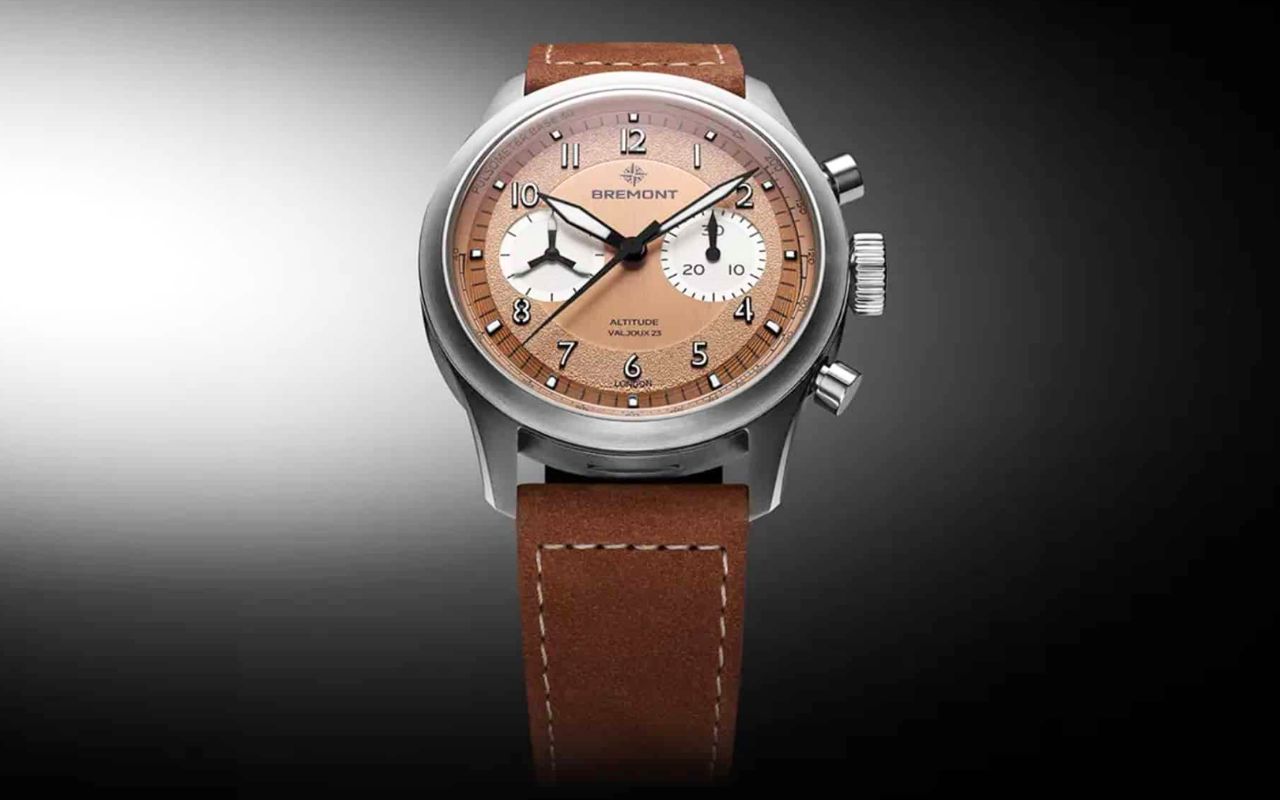
Bremont is leaning hard into a familiar fantasy in watchmaking: take a legendary machine from the past, extract a real physical fragment of it, and lock that story into a wristwatch you can buy today.
The brand’s aviation-driven collections, from the H-4 Hercules to the DH-88 Comet, are built to feel like artifacts, not just accessories. And yes, the hook is tangible, in some models, original material from historic aircraft is integrated into the watch. That strategy lands at a moment when mechanical watches are competing less on utility and more on meaning. A phone tells time better than any automatic movement, so brands sell identity, provenance, and craft. Bremont’s angle is unusually direct: British engineering, British manufacturing at scale for cases and selected parts, and testing designed to prove durability. The result is a product that reads like history, but is priced and positioned like modern luxury.

Bremont ties the H-4 Hercules to real aircraft material
The H-4 Hercules, better known by its nickname “Spruce Goose,” remains one of aviation’s most mythologized projects, massive, ambitious, and forever linked to the idea of pushing engineering past common sense. Bremont’s H-4 Hercules Collection borrows that cultural weight and translates it into watch design language: robust cases, sculpted profiles, and a narrative that frames the watch as a tribute to boundary-pushing engineering.
The detail that does most of the work is material authenticity. Bremont highlights the incorporation of original birchwood from the aircraft’s fuselage in the collection. In luxury terms, that is a shortcut to scarcity: the supply is finite by definition, and the story is difficult for competitors to copy without access to comparable artifacts. It’s not just “inspired by,” it’s “containing,” which changes how collectors talk about it.
From a consumer point of view, this is where desire becomes rationalized. A buyer can tell themselves they are not paying only for finishing and branding, but for a physical link to a famous machine. Watch retailers have long seen this effect with “meteorite dials” or reclaimed materials, but Bremont’s aircraft tie-in feels more personal because it connects to pilots, air shows, and restoration culture, not just geology.
There’s a trade-off, and it’s worth stating plainly. When a product leans on relic material, the watch risks becoming more about the anecdote than the object. If the design and execution don’t stand alone, the story can start to feel like a crutch. Bremont’s challenge is to make the aviation heritage additive, not compensatory, especially at luxury price points where buyers compare finishing, movement pedigree, and long-term service expectations.
Nick and Giles English built Bremont from a near-tragedy
Bremont’s origin story is unusually specific, and the company leans into it because it reads like the beginning of a novel. Founders Nick English and Giles English grew up making and restoring things in their father’s workshop. Their father, Euan, was an ex-RAF pilot with a PhD in aeronautical engineering, and the brothers even helped him build an aircraft they still fly. That early mix of hands-on craft and aviation is the brand’s backbone.
Then comes the event that reframes everything. In March 1995, during preparation for an air display, a 1942 WWII Harvard aircraft was involved in an accident. Euan was killed, and Nick suffered severe injuries, including over 30 broken bones. The way the company tells it, the recovery and return to flying became a turning point: life felt too short to postpone building something meaningful, and the brothers decided to pursue engineered mechanical devices.
There’s another piece that explains the brand name and its tone. In the late 1990s, the brothers were flying a 1930s biplane across France when worsening weather forced an emergency landing. A farmer sheltered them, their aircraft, and their anxiety about local authorities. The farmer’s home was filled with half-restored wall clocks and engine parts, and he wore his own father’s wristwatch. His name was Antoine Bremont, and the brand name is positioned as a promise to remember that hospitality.
That story matters because it’s not abstract marketing copy, it’s a narrative about risk, repair, and mechanical empathy. It also sets expectations. If you buy a Bremont, you’re buying into an ethos: aircraft, endurance, and workshop culture. But that also invites scrutiny. If the product experience ever feels too polished, too corporate, or too detached from the tool-watch spirit, the contrast with the founders’ story becomes noticeable, and collectors can be unforgiving.

Bremont manufactures cases in Silverstone, a rare UK scale
The brand’s most concrete differentiator is manufacturing ambition in a market dominated by Switzerland. Bremont says it now manufactures its own cases and selected movement parts at its facility in Silverstone, in the UK. In an industry where “assembled in” language often does heavy lifting, the decision to invest in domestic production is a strategic statement about control, supply chain resilience, and national identity.
Bremont also frames this as something close to a historical correction. The company points to the 1800s, when Britain produced a huge share of the world’s clocks and watches, and argues that industrial high-end watchmaking can return to British shores. It positions its work as part of a broader comeback narrative for British watchmaking, with the implied message that buyers are supporting more than a brand, they are supporting a manufacturing ecosystem.
In practical terms, making cases in-house changes what a brand can do. Case geometry, finishing choices, and iterative prototyping become faster and less dependent on external suppliers. It also makes limited runs more plausible, because the bottleneck is internal capacity rather than a supplier’s priorities. For collectors, “made in the UK” becomes more than a slogan when you can point to a facility and a defined scope of parts produced there.
Still, there’s a nuance that matters for credibility. Bremont describes making cases and some movement parts, not full movements across the board. That distinction is normal in watchmaking, but it’s where enthusiasts start asking detailed questions: what’s proprietary, what’s sourced, and how does it compare with Swiss competitors at similar prices. Bremont’s best move is transparency and consistency, because the moment the message feels overstated, the “British manufacturing” claim becomes a lightning rod.
Bremont’s H1 Timing Standard sells testing as a feature
Durability testing is often mentioned in luxury watch marketing, but Bremont elevates it into a core product feature. The company describes watches as among the most precise mechanical devices on the planet, and it says its pieces are subjected to rigorous testing in the workshop and in the field by ambassadors and partners. The tone is clear: these are meant to survive more than desk duty, even if many will spend their lives in offices.
A key detail is the brand’s approach to movement testing with the rotor attached. Bremont describes testing the movement complete with the rotor in place, in the same facility where the watches are built, to reduce potential variance in performance that can come from detaching and reattaching the rotor after testing. That’s a small process choice, but it signals a manufacturing mindset: treat assembly as a system, not a series of isolated steps.
The company also names its chronometer-testing concept the H1 Timing Standard, a nod to its home in Henley-on-Thames and an homage to John Harrison’s first “H1” marine timekeeper, tied historically to solving the longitude problem at sea. It references the tradition of observatory testing in England, including Kew Observatory, and positions its effort as a reinvigoration of a British chronometer test culture.
Here’s the critique: testing narratives can drift into vague bravado if they don’t translate into clear user value. Buyers want to know what standards mean in daily wear, service intervals, and long-term consistency. Bremont’s messaging is strongest when it stays specific, like the rotor-attached testing detail, and weaker when it leans into slogans. In a luxury market where competitors also claim toughness, the brand has to keep proving what “tested beyond endurance” delivers on the wrist.
Altitude and America’s Cup models show the price ladder
Beyond the myth-making collections, Bremont also sells modern sports and travel watches with straightforward specs and pricing that map its market position. Examples listed by an authorized retailer include an America’s Cup model in steel at $5,700, the Altitude MB Meteor in titanium at $5,300, and the Altitude 39 Date in steel at $4,550 on bracelet, or $4,250 on strap. Those numbers matter because they place Bremont in a competitive band where buyers cross-shop aggressively.
Case size and material choices also show how the brand balances tool-watch cues with everyday wearability. The Altitude models are listed at 39mm and 42mm, with steel and titanium options. In 2026, that sizing is a sweet spot for many enthusiasts who want presence without oversized bulk. Titanium at this price is also a statement, suggesting the brand expects buyers to value lightness and durability, not just shine.
What turns these from “nice watches” into “objects of desire” is the way Bremont connects the contemporary catalog to its aviation identity. Even when a model isn’t literally built from historic aircraft material, it sits under the same umbrella of flight, engineering, and endurance. That consistency is valuable. In luxury, confusion kills momentum. A brand that can make a buyer understand the point of the product in ten seconds has an advantage at the display case.
But the same price ladder creates pressure. At roughly $4,250 to $5,700, customers expect not only strong design and finishing, but also a clear reason to pick Bremont over Swiss stalwarts with decades of prestige in the same bracket. Bremont’s answer is British manufacturing investment, testing culture, and credible aviation storytelling. Whether that outweighs the gravitational pull of Swiss heritage depends on the buyer, and that’s where the brand’s “myth revived” strategy either becomes magnetic or starts to feel niche.
À retenir
- Bremont uses real historic aircraft material in select aviation tribute watches to create scarcity and provenance.
- The brand’s identity is built around aviation, workshop culture, and a founder story rooted in loss and rebuilding.
- Manufacturing cases and selected parts in Silverstone supports a rare “made in the UK” claim at scale.
- Process details like rotor-attached testing help Bremont make durability feel measurable, not just a slogan.
- With prices roughly $4,250 to $5,700, Bremont competes directly with Swiss brands and must justify its premium through differentiation.
Questions fréquentes
- What “mechanical myth” is Bremont reviving with its aviation collections?
- Bremont taps into legendary aircraft narratives, notably the Hughes H-4 Hercules, and translates that mythology into watch design and storytelling. In the H-4 Hercules Collection, the brand goes further by incorporating original birchwood from the aircraft’s fuselage, turning a famous engineering story into a wearable, collectible object.
- Are Bremont watches actually made in the UK?
- Bremont states that it manufactures its own cases and selected watch parts at its facility in Silverstone, UK. That is a meaningful claim in an industry heavily dependent on Swiss supply chains. At the same time, the brand does not present itself as making every component entirely in-house, so the scope is important for buyers comparing manufacturing depth across brands.
- What is the H1 Timing Standard and why does it matter?
- The H1 Timing Standard is Bremont’s framing for chronometer-style testing, named in homage to John Harrison’s H1 marine timekeeper and tied to British observatory-testing tradition. Bremont also highlights process choices, like testing movements with the rotor attached, to reduce performance variance introduced by post-test disassembly and reassembly.
- How much do Bremont’s mainstream models cost in the current lineup?
- Examples listed by an authorized retailer include an America’s Cup steel model at $5,700, an Altitude MB Meteor in titanium at $5,300, and an Altitude 39 Date in steel at $4,550 on bracelet or $4,250 on strap. Prices and configurations place Bremont in a competitive luxury segment where buyers often cross-shop Swiss brands.
