

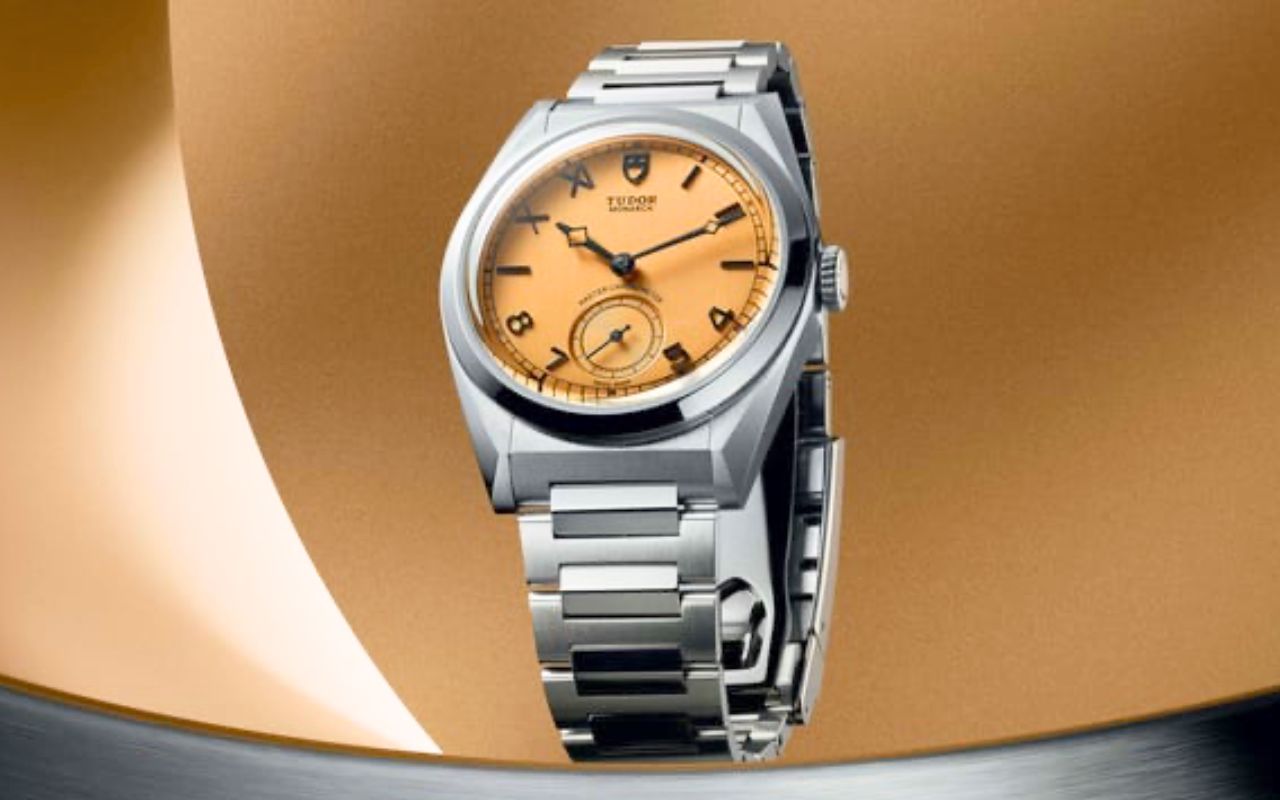
The new Tudor Monarch arrives with a dial that practically argues with you, in a good way. Tudor calls it “error-proof,” and the idea is simple: mix Roman numerals on the upper half with Arabic numerals on the lower half, a layout collectors often label a California dial.
The result is a face that’s instantly legible, visually distinctive, and hard to misread at a glance. Released in 2026, the Monarch is also a technical statement: a 39mm stainless-steel case, a Manufacture movement labeled MT5662-2U, a 65-hour power reserve, and 100 meters of water resistance. That spec sheet puts it squarely in sport-luxury territory, while the dial texture and typography lean into vintage cues. It’s a deliberate mash-up, and it won’t be everyone’s taste, but it’s hard to call it timid.

Tudor revives the “error-proof” California dial in 2026
The Monarch’s headline feature is its “error-proof” dial, built around two numeral systems. From roughly 10 to 2 you get Roman numerals, while 4 to 8 switches to applied Arabic numerals. In practical terms, your brain doesn’t have to work as hard to confirm orientation, because the top and bottom halves don’t look the same. That’s the point: reduce the chance of a quick, sloppy misread when you glance down mid-conversation.
There’s also a design logic here that’s more than novelty. Split-numeral dials have a long history in watchmaking, and the Monarch leans into that tradition without copying a single vintage reference outright. The applied markers give the dial depth, and the overall layout looks intentionally “wrong” in a way that becomes coherent after about five seconds on the wrist. If you’ve ever mixed up 12 and 6 on a minimalist dial in low light, you get the appeal.
One detail that changes the vibe is the running seconds subdial at 6 o’clock. Instead of a central seconds hand sweeping the entire dial, the Monarch keeps seconds in their own little register. That’s a classic presentation, and it reinforces the idea that Tudor is aiming for an old-school visual rhythm, even while the rest of the watch, case integration, clasp, finishing, feels modern. It’s a smart contrast, and it keeps the dial from becoming a pure typography exercise.
But let’s be honest, the look is polarizing. The California layout can read like a collector in-joke, and some buyers will see it as a gimmick dressed up as history. That critique isn’t crazy. Tudor’s counterargument is that the Monarch isn’t trying to be neutral, it’s trying to be unmistakable, and in a market full of safe black dials, “unmistakable” is a strategy.
The 39mm faceted steel case targets sport-luxury wearability
The Monarch’s case is 39mm in stainless steel, with a distinctive faceted geometry and sharp lines that Tudor highlights as part of its centenary aesthetic language. Thickness is listed at 11.9mm, and the lug-to-lug measurement comes in at 46.2mm, numbers that matter if you’re trying to predict how it will sit on an average wrist. It’s compact enough to avoid “dinner plate” proportions, but not so small that it disappears.
Tudor pairs that case with a matching integrated bracelet design, built around an H-link style and a clasp that includes the brand’s T-fit adjustment system. The practical benefit is quick sizing changes without tools, which sounds minor until you actually live with it through summer heat, travel, or a long day when your wrist swells. This sort of micro-adjust has become a must-have in the segment, and Tudor clearly doesn’t want the Monarch to feel behind the curve.
Water resistance is rated to 100 meters, and the crown is described as screw-down steel. That combination signals a watch that can handle real daily life, not a fragile dress piece that panics near a sink. In the sport-luxury bracket, 100 meters is a common baseline, and it’s enough for surface swimming and general rough use, even if it’s not marketed as a dedicated dive watch.
Still, sport-luxury is a balancing act. Faceted cases with polished and satin surfaces can pick up scratches, and an integrated bracelet can limit strap options for people who like to swap looks. If you’re the type who rotates leather, rubber, and NATO straps, the Monarch’s integrated design may feel restrictive. Tudor is betting that the cohesive case-and-bracelet silhouette is worth that trade-off.

The champagne papyrus dial adds texture and deliberate vintage cues
Tudor describes the dial’s hue and texture as reminiscent of papyrus, the ancient writing material used across Egypt and the Classical world. On the Monarch, that idea translates into a champagne tone with a vertical brushing effect. Under changing light, brushed dials can shift from matte to shimmering, and that’s the kind of detail that makes a watch feel more expensive than a flat lacquer surface.
Applied numerals and markers do a lot of work here. The upper Roman numerals and lower Arabic numerals aren’t just printed, they’re raised, which creates shadows and improves separation from the dial surface. That matters because a textured dial can sometimes fight legibility. By using applied elements, Tudor keeps the “papyrus” concept from becoming visual noise. It’s a design decision that supports the “error-proof” promise, not just the mood board.
The running seconds subdial at 6 o’clock also helps organize the dial. It gives your eye a clear anchor point, and it breaks up what could have been a busy mix of numerals, markers, and texture. It’s a traditional display method, and it fits the Monarch’s broader theme of referencing older watchmaking language while using a modern case and bracelet architecture.
There’s a risk, though: champagne dials can be tricky in photos and unpredictable in person. Some wearers love the warmth; others want stark contrast, especially if they’re used to black or white dials. The Monarch is not trying to be a one-watch-for-everyone solution. It’s more like a watch that rewards people who are bored with safe choices, while still being grounded enough to wear with a suit or a T-shirt.
MT5662-2U movement brings 65-hour reserve and dual certification
Inside the Monarch is the Manufacture Calibre MT5662-2U, described with traditional finishing touches and positioned as a unique caliber within Tudor’s lineup. The performance headline is a 65-hour power reserve, which is practical in a way people immediately understand. Take it off Friday night, pick it up Monday morning, and there’s a decent chance it’s still running, depending on when you set it down.
The movement is listed as certified by both COSC and METAS. In plain terms, that signals a focus on precision and a higher bar of testing than basic in-house regulation. METAS certification is often associated with modern expectations around accuracy and robustness. For buyers comparing watches in the $5,000-plus space, certifications can become shorthand for credibility, especially when brand marketing starts to sound the same across competitors.
Tudor also notes elevated finishing details, including Côtes de Genève, perlage, and an 18 ct gold layer on the rotor. These are the kinds of touches that matter most to owners who actually look at movements, whether through servicing conversations or collector curiosity. Even if the Monarch isn’t sold as a pure exhibition-piece watch, the finishing language is Tudor telling enthusiasts: this isn’t just about the dial trick.
That said, a movement spec sheet doesn’t automatically translate into emotional appeal. Some buyers care more about how the watch reads at arm’s length than what’s happening under the hood. The Monarch’s challenge is that its dial is the loudest story, so Tudor has to work harder to convince skeptics that the mechanics deserve equal attention. The dual certification and 65-hour reserve are the brand’s best arguments.
Pricing, warranty, and how the Monarch fits Tudor’s century narrative
Tudor positions the Monarch as a new watch with a name tied to a century of brand legacy, and the timing is not subtle. The release lands in 2026, marking 100 years since the brand name was registered. The messaging is about continuity, but the product itself is about standing out. That tension is interesting: celebrating heritage while choosing a dial layout that refuses to blend in.
On the commercial side, the listed price is 5,520 for the configuration presented with the champagne dial and steel bracelet. In the sport-luxury landscape, that places it in a crowded lane where buyers cross-shop on finishing, movement credibility, and brand strength. Tudor’s value proposition has long been “serious watchmaking at a comparatively accessible price,” and the Monarch leans on that identity while looking more niche than a standard three-hander.
The warranty is stated as five years, transferable, with no registration or intermediate checkups required. That’s a consumer-friendly policy, and it’s also a quiet signal of confidence. For buyers who worry about long-term ownership costs, warranty terms can influence a decision more than a small difference in case thickness or lug-to-lug numbers. Transferability also matters in a market where many watches change hands.
Where does it fit in the lineup? The Monarch reads like a deliberate side-step from the safer, more familiar Tudor silhouettes. It’s a watch that asks the wearer to commit to a specific aesthetic, and that can limit its mainstream appeal. But if Tudor’s goal is to remind people it has more range than the obvious hits, the Monarch does that job. It’s a modern product with a vintage accent, priced and specced to compete, and designed to spark debate at the table.
To remember
- The Tudor Monarch uses an “error-proof” California dial mixing Roman and Arabic numerals for fast orientation.
- A 39mm steel case, 11.9mm thickness, and 100m water resistance position it as daily-wear sport-luxury.
- The MT5662-2U Manufacture movement offers a 65-hour power reserve with COSC and METAS certification.
- A champagne, papyrus-like brushed dial and running seconds subdial push a deliberate vintage-meets-modern look.
- At €5,520 with a transferable five-year warranty, Tudor aims for value within the premium segment.
FAQ
- What does Tudor mean by an “error-proof” dial on the Monarch?
- It refers to the split-numeral layout: Roman numerals appear on the upper half of the dial and applied Arabic numerals on the lower half. The contrasting halves make it easier to confirm orientation quickly, reducing the chance of misreading the watch at a glance.
- What are the main specs of the Tudor Monarch?
- Key specs include a 39mm stainless-steel case, 11.9mm thickness, 46.2mm lug-to-lug, 100 meters of water resistance, a screw-down crown, sapphire crystal, and a steel bracelet with Tudor’s T-fit clasp system.
- What movement is inside the Tudor Monarch, and what is its power reserve?
- The Monarch uses the Manufacture Calibre MT5662-2U. Tudor states a 65-hour power reserve, designed to keep the watch running through extended time off the wrist, such as a weekend.
- Is the Tudor Monarch movement certified for accuracy?
- Yes. The MT5662-2U is listed as certified by both COSC and METAS, signaling formal testing standards focused on precision and performance.
- How much does the Tudor Monarch cost and what warranty does it include?
- The listed price is €5,520 for the model presented with the champagne dial and steel bracelet. Tudor states a transferable five-year warranty with no registration and no intermediate checkups required.
