

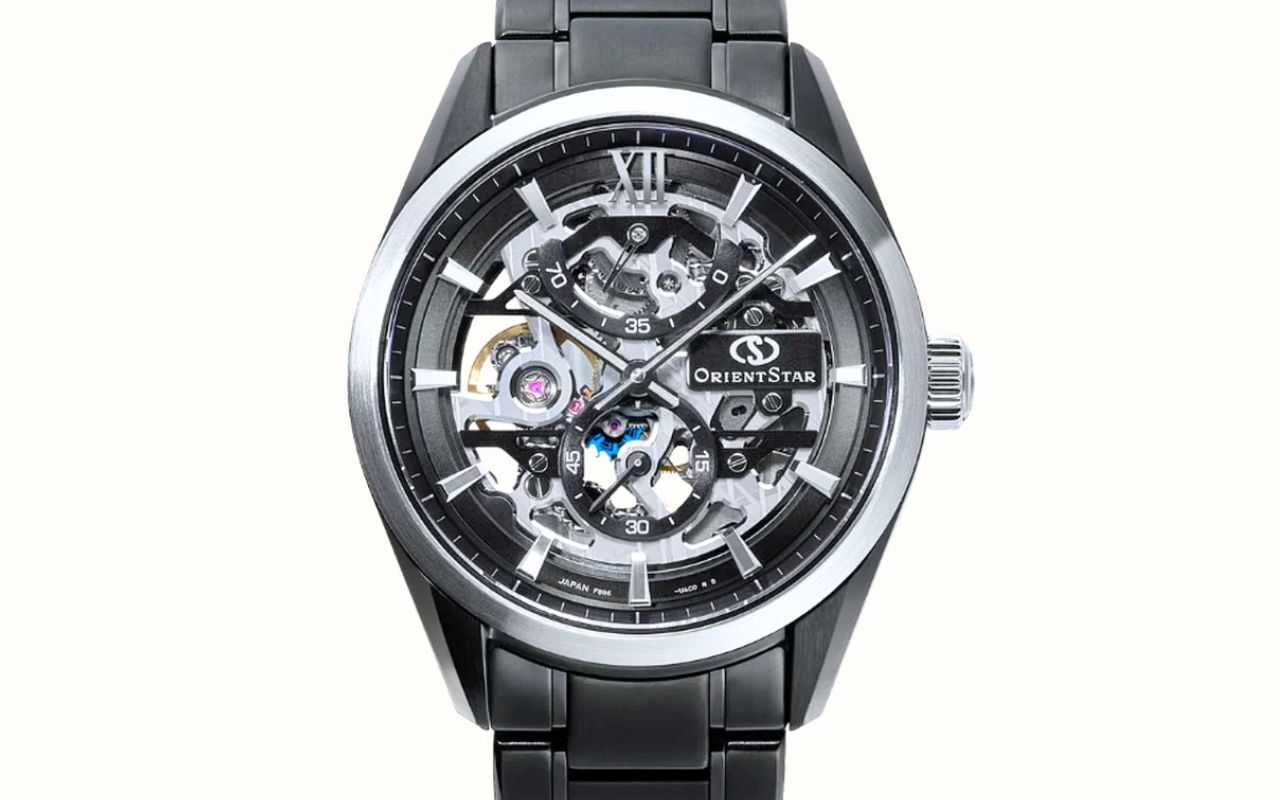
Orient Star is using its 75th anniversary to push one of its most technical modern designs into the spotlight, the M34 F8 Skeleton.
The limited-edition release leans hard into openworked architecture, cosmic-themed details, and a dial-to-caseback finish meant to evoke a meteorite surface, all wrapped around an in-house, manual-winding movement. This launch lands at a moment when Japanese mechanical watchmaking is getting sharper attention in Europe, where Orient Star has long been known for accessible classics like the Bambino, but less for higher-spec statement pieces. The anniversary watch is meant to show what the brand can do when it prioritizes engineering and finishing, even if that means moving into a price tier that invites tougher comparisons.

Orient Star ties the M34 line to Perseus and the “cosmic” design code
The anniversary story is not just a number on a caseback, it is a design framework. Orient Star’s Contemporary Collection M34 is named after the Perseus star cluster, a reference that keeps showing up in the brand’s language, textures, and small mechanical flourishes. With the M34 F8 Skeleton, that theme is made literal through a mix of crystalline surfaces and space-inspired shapes that aim to feel engineered, not decorative.
The most noticeable choice is the way the skeletonized layout is paired with a crystal-like texture created through advanced laser processing. It is meant to read like a fragment of something extraterrestrial, with light catching on irregular facets rather than a uniform brushing. If you have handled watches that try to do “space” with just a starry dial print, this is more tactile and more ambitious, because the texture is part of the structure, not an overlay.
Orient Star also adds specific celestial cues. There is a comet-shaped balance bridge, and the escape wheel is designed to suggest a spiral similar to the Milky Way. This is the kind of detailing that can look gimmicky if it is too obvious, but here it is integrated into parts that already matter mechanically. It gives the watch a narrative without turning it into a novelty piece.
That said, the cosmic design code is a tightrope. The same elements that make the watch distinctive can also narrow the audience. A fully traditional dress-watch buyer may find the look too modern and too busy, especially compared with the calmer identity of many classic Orient models. Orient Star seems fine with that tradeoff, because the anniversary is being used to underline confidence in the brand’s contemporary direction.
The manual-wind F8B65 targets +15/5 seconds and 70 hours
At the center of the M34 F8 Skeleton is the in-house, manual-winding Caliber F8B65. Orient Star positions this movement as part of its manufacturing identity, built on the proven F8 platform but tuned and presented for a more enthusiast-facing watch. On paper, the specs are the kind collectors actually discuss: stated accuracy of +15 to 5 seconds per day and a 70-hour power reserve.
The movement also includes a silicon escape wheel made using advanced MEMS manufacturing. Silicon components have become a talking point because they can improve consistency and reduce sensitivity to certain factors, and they are still more commonly associated with higher-priced Swiss offerings. Orient Star is not alone in using silicon, but it is a meaningful signal in this segment, because it shows the brand is investing in industrial capability, not just case design.
Manual winding changes how the watch fits into daily use. You are asked to interact with it, and the openworked display encourages that. A 70-hour reserve means you can set it down for a weekend and come back without it being dead on Monday morning, which is practical, not just marketing. If you rotate watches, that buffer matters more than people admit, because it reduces the “reset friction” that often pushes owners toward quartz for weekdays.
Here is the nuance, and it is worth saying plainly. Stated accuracy is not the same as real-world performance on your wrist, and skeletonized watches sometimes invite harsher scrutiny because the whole point is to show the mechanism. If a buyer is expecting chronometer-level numbers, the published range will not satisfy them. Orient Star is betting that the combination of in-house engineering, silicon tech, and visual drama is the value proposition, not a promise of ultra-tight regulation.
The skeleton build uses laser-treated crystalline texture and a meteorite-like finish
The anniversary edition leans on surfaces and depth more than color. The skeleton construction is presented as a way to reveal complexity, and Orient Star amplifies that with a crystalline texture achieved through advanced laser treatment. The effect is meant to resemble the fractured, reflective look you see in meteorite imagery, but executed as finishing across visible components rather than a simple dial material swap.
One of the more distinctive choices is that the meteorite-like finishing is described as extending from the dial side through to the caseback, reinforcing a single identity rather than treating the front and back as separate design projects. That continuity is important in a skeleton watch, because you are inevitably going to flip it over. A lot of brands forget that and leave the back feeling like an afterthought.
Orient Star also makes the celestial references functional. The comet balance bridge and the spiral-like silicon escape wheel are not random shapes glued onto a dial, they are parts you would expect to see in an openworked watch. That is a smart way to keep the theme grounded in mechanics. It gives collectors something to point to when explaining the watch, beyond “it looks cool.”
Still, there is a legitimate critique: textures this aggressive can dominate the experience. In certain lighting, high-contrast facets can reduce legibility and make the watch feel more like a technical sculpture than a time-reading tool. Some buyers want exactly that, but it is a choice. If your priority is instant readability, a more conventional M34 variant, including the meteorite-dial Date model in the anniversary lineup, may be the more balanced daily-wear option.
European availability and anniversary positioning move Orient Star upmarket
Orient Star is making the M34 F8 Skeleton available through a selection of retailers in Europe, and that distribution detail matters. Europe is a market where Japanese brands often get pigeonholed as value alternatives rather than objects of desire. By placing a limited anniversary skeleton piece in that retail environment, Orient Star is asking to be evaluated next to entry-level Swiss mechanical watches, and next to better-known Japanese peers that dominate mindshare.
The brand’s reputation in Europe has often been tied to accessible staples, with the Bambino frequently cited as a calling card for Japanese dress watches that do not destroy a budget. Anniversary releases like the M34 F8 Skeleton are a different message. They say the company wants to be taken seriously for in-house engineering and finishing, not just for delivering “good for the money” classics.
That repositioning is part of a broader anniversary strategy. Orient’s official anniversary communication highlights a long timeline, from the brand’s founding in 1950 to technical milestones like the 1976 Touchtron developed with Sharp, described as the first watch to light an LED and display time when the case is touched. Mentioning those moments is not nostalgia for its own sake, it is a way to argue that experimentation has always been part of the brand’s DNA.
There is also a market reality here that no brand can ignore. Limited editions can create urgency, but they can also trigger skepticism, because collectors have seen “anniversary” slapped onto watches that do not feel special. Orient Star’s answer is to load the watch with tangible technical and finishing points, manual in-house caliber, silicon componentry, laser textures. Whether that is enough to justify a move upmarket depends on the buyer’s reference points, and on how the watch feels in hand, not just on a spec sheet.
The 75th anniversary lineup includes meteorite dials and multiple limited editions
The M34 F8 Skeleton is not the only anniversary headline. Orient Star is also using the 75th milestone to introduce its first meteorite dial on the M34 F8 Date 75th Anniversary Limited Edition, a clear attempt to compete visually with brands that rely on louder recognition. Meteorite is one of those materials that instantly signals “special edition,” because no two dials are identical, and collectors tend to treat that uniqueness as inherently valuable.
That M34 F8 Date Meteorite model is described with a 40mm stainless steel case, 12.9mm thickness, and 100m water resistance, plus sapphire crystals and an engraved caseback marking the anniversary and an individual serial number. It runs on the in-house automatic F8N64, operating at 21,600 vibrations per hour with a 60-hour power reserve and the same stated accuracy range of +15/5 seconds per day. Put simply, Orient Star is giving buyers two different “space” interpretations, one focused on material, one on mechanics.
Independent commentary around the anniversary collection has also pointed out that Orient Star seems more deliberate than purely celebratory, spreading limited editions across core lines rather than doing one commemorative piece. One enthusiast writer framed it as the brand “winning attention over Seiko,” which is not a small claim in the Japanese watch ecosystem. The point is not that Orient Star has replaced Seiko in the hierarchy, it is that the brand is forcing a second look from people who used to dismiss it as a side option.
The caution is that anniversary collections can stretch a brand’s identity if pricing and design move too far, too fast. If the top-end limited editions climb beyond what long-time buyers expect, you risk losing the “safe recommendation” status that helped build the audience. Orient Star’s 75th strategy looks like a bet that there is room to grow without abandoning its value reputation, but the market will decide that over the next release cycles, especially once these pieces are seen on wrists rather than in controlled photos.
To remember
- Orient Star’s M34 F8 Skeleton is a 75th anniversary limited edition built around a cosmic-themed skeleton design.
- The in-house manual-wind F8B65 lists +15/−5 seconds per day accuracy and a 70-hour power reserve, with a silicon escape wheel made via MEMS.
- Orient Star is pairing anniversary storytelling with tangible specs and finishing to support a more upmarket position in Europe.
- The broader 75th lineup also introduces the brand’s first meteorite dial on the M34 F8 Date anniversary edition.
Q&A
- What makes the Orient Star M34 F8 Skeleton a 75th anniversary watch?
- It is presented as a limited-edition anniversary release with a cosmic-inspired skeleton architecture, a meteorite-like crystalline finish created through advanced laser processing, and commemorative positioning within the brand’s 75-year timeline.
- What are the key specs of the F8B65 movement in the M34 F8 Skeleton?
- The in-house manual-winding Caliber F8B65 is stated at +15 to −5 seconds per day accuracy with a 70-hour power reserve. It is based on the F8 platform and includes a silicon escape wheel produced using MEMS technology.
- Is Orient Star also releasing a meteorite-dial model for the 75th anniversary?
- Yes. The M34 F8 Date 75th Anniversary Limited Edition is described as the first Orient Star to use a meteorite dial, emphasizing that each dial is unique and pairing it with an in-house automatic movement and anniversary engravings.
- Where will the M34 F8 Skeleton be sold?
- The watch is slated to be available through a selection of retailers in Europe, reflecting the brand’s effort to strengthen its presence and positioning in that market.
Sources
- L’Orient M34 F8 Skeleton célèbre le 75ème anniversaire de la marque horlogère japonaise
- M34 F8 Date Meteorite | Montres Orient Site Officiel France
- Introducing: Orient Star M34 F8 Date Meteorite 75th Anniversary
- Orient : 75e anniversaire | Montres Orient Site Officiel France
- I Never Thought I’d Say This, but Orient Star Is Winning My Attention Over Seiko | Two Broke Watch Snobs
