

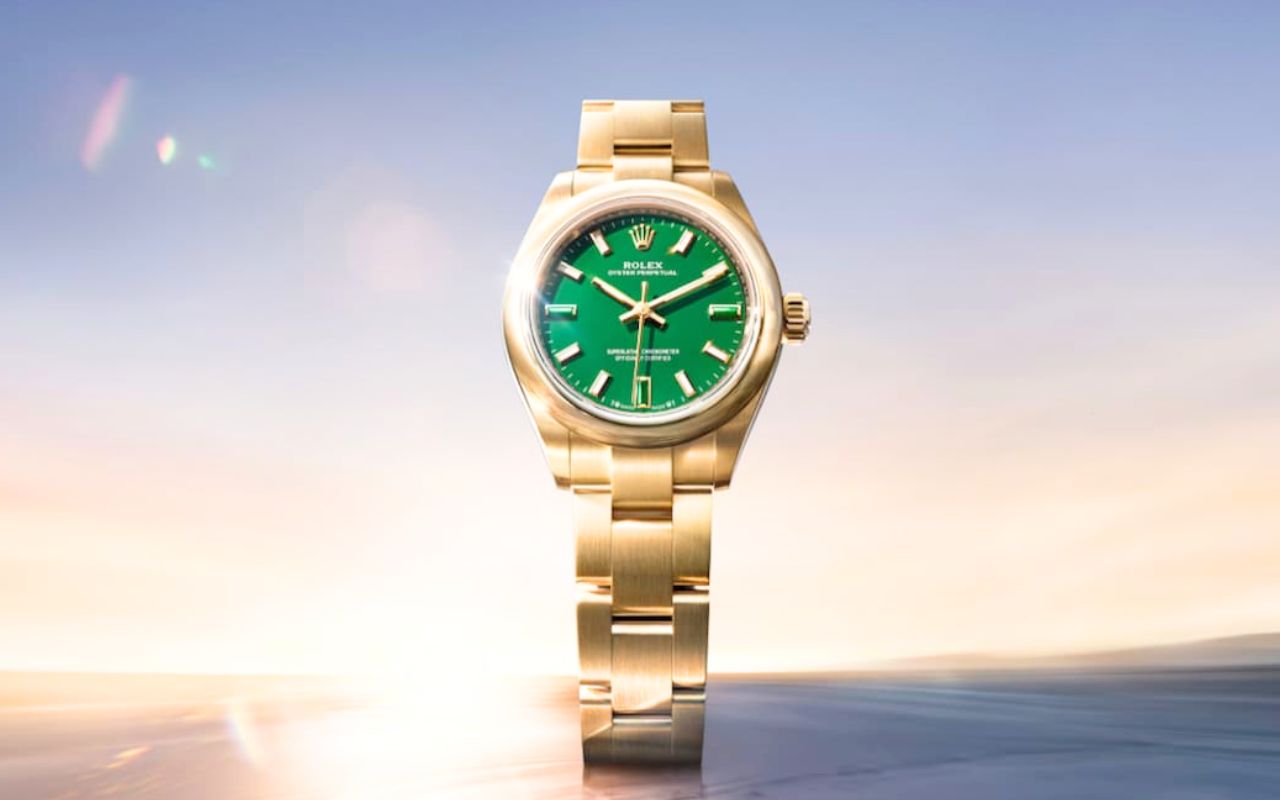
Rolex is pushing the Oyster Perpetual into a more precious lane, with two new references built entirely in 18 ct gold and sized at 28 mm and 34 mm.
The formula stays recognizably Oyster Perpetual, smooth dial, domed bezel, Oyster bracelet, but the execution changes the tone: stone-lacquer colors, natural stone hour markers, and a finish strategy that leans on satin more than mirror shine. The headline details are simple and unusually specific. The 28 mm version comes in 18 ct yellow gold with a green stone-lacquer dial. The 34 mm version comes in 18 ct Everose gold with a blue stone-lacquer dial. At 3, 6, and 9 o’clock, the hour markers are natural stone, described as a first for Rolex in this context, a small change on paper that carries a big signal to collectors.
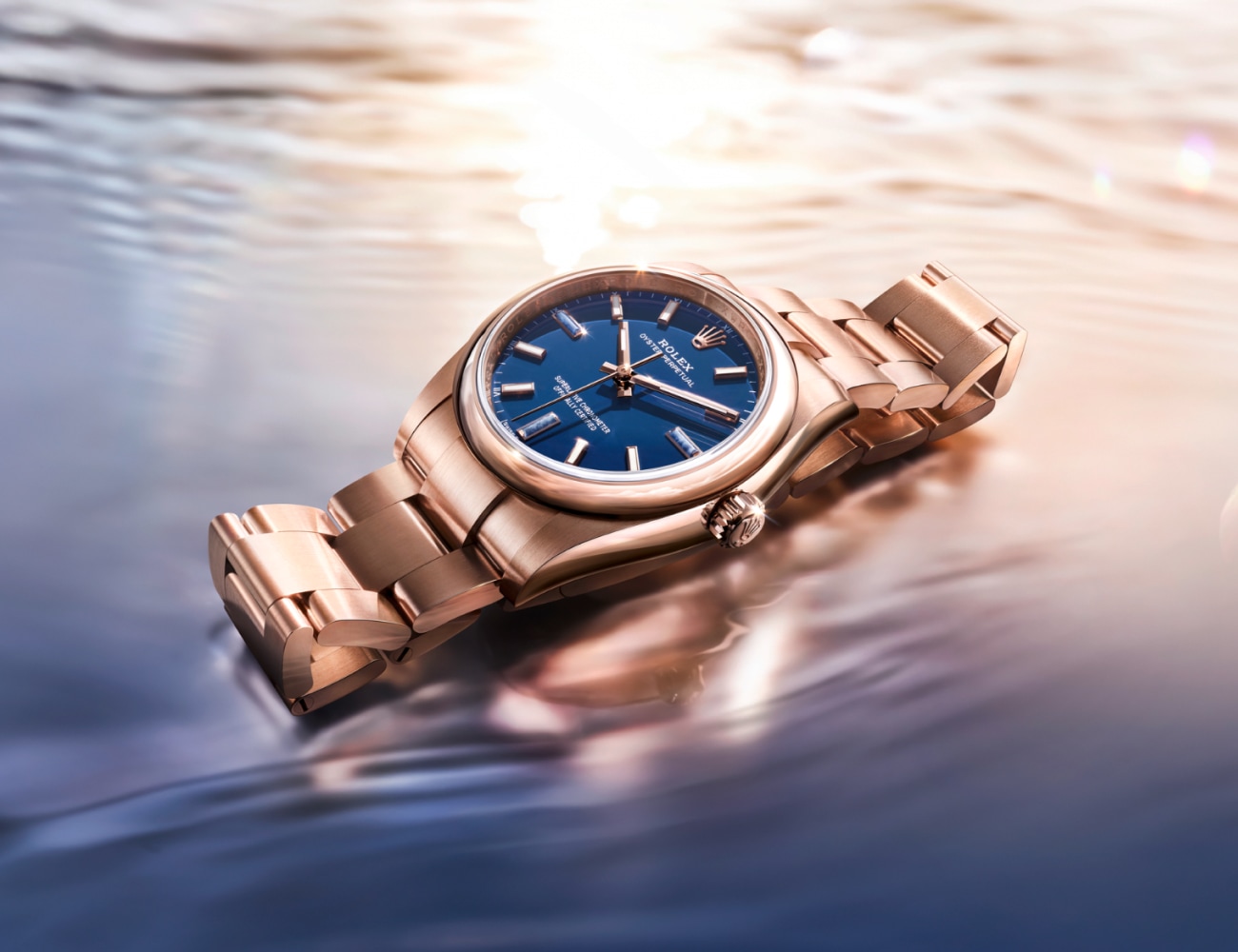
Rolex specifies 18 ct yellow gold and Everose for two sizes
The new pairing is split by both size and alloy. The Oyster Perpetual 28 is fashioned in 18 ct yellow gold, while the Oyster Perpetual 34 is produced in 18 ct Everose gold. That decision matters because it positions the watches as distinct personalities rather than the same product scaled up or down. Yellow gold reads classic and high-contrast, Everose is warmer and more nuanced, especially under mixed indoor lighting.
Rolex also keeps the case proportions tight. The 28 mm is listed at 10.50 mm thick, the 34 mm at 10.60 mm. Those numbers are small enough to keep the watches from feeling top-heavy, which can happen quickly when you move an entry-level steel design into precious metal. In practice, a tenth of a millimeter is not a comfort revolution, but it signals that the brand is controlling the architecture rather than letting gold dictate bulk.
Both models stick with the familiar Oyster construction and daily-wear specs. Water resistance is stated at 100 meters, and the bracelet is an Oyster bracelet with an Oysterclasp and Easylink extension. That combination is part of what makes the Oyster Perpetual line a “wear it and forget it” proposition for a lot of owners: you can swim, you can travel, you can adjust the fit when your wrist changes with heat.
There is also a market context hiding behind the sizing. Rolex already sells Oyster Perpetual models in steel across multiple diameters, including 34 mm with a published US list price of $6,400 for an Oystersteel configuration. Moving the 28 mm and 34 mm into full gold doesn’t just add a premium option, it reframes smaller diameters as serious, flagship-level products. If you’ve been hearing that “small watches are back,” this is the kind of release that turns the talk into inventory.
Green and blue stone-lacquer dials introduce a new texture cue
Color is doing heavy lifting here. The 28 mm gets a green stone-lacquer dial, while the 34 mm gets a blue stone-lacquer dial. Rolex describes its lacquer process in controlled conditions to avoid dust and contamination, and that matters more when the brand is chasing a saturated, uniform field of color. Any defect would be more visible on these kinds of dials than on a textured or patterned surface.
What changes with “stone lacquer” is the idea that the dial is not only about gloss. The releases emphasize material nuance and texture, the kind of detail you notice when you tilt the watch in natural light rather than when you stare at it head-on. For buyers used to the Oyster Perpetual as the cleanest, most straightforward Rolex dial, this is a subtle pivot: the watch stays minimal, but the surface has more to say.
Dial color also interacts with the metal choice in a way that can’t be reduced to taste. Blue against Everose gold tends to look deeper and less obvious than blue against yellow gold, and green against yellow gold can swing from sporty to jewelry-like depending on wardrobe and environment. You’ll see it in real life in places like a restaurant patio at dusk, where warm ambient light can soften the dial while the polished bezel catches bright highlights.
One nuance worth stating plainly: these are not the loudest dials Rolex has ever made, but they are not “safe” either. Green and blue are popular in the market, but the combination of stone-lacquer language and precious metal can polarize buyers who want the Oyster Perpetual to remain the brand’s simplest, most utilitarian face. If you’re the sort of collector who prefers the steel OP as a low-key daily watch, this gold-and-stone direction may feel like Rolex moving the goalposts.
Natural stone markers at 3, 6, 9 debut on Oyster Perpetual
The most concrete novelty is at the cardinal points. Rolex says the hour markers at 3, 6, and 9 o’clock are crafted from natural stone, described as a first for the brand in this application. On the 34 mm, the markers are set with dumortierite, and on the 28 mm they use heliotrope. Those are not typical “look at me” gems, and that choice feels intentional.
Rolex pairs the stones with applied gold markers, specified as 18 ct pink gold markers on the Everose model and 18 ct yellow gold markers on the yellow-gold model. The stones are integrated into that system rather than replacing the indices entirely, which keeps legibility familiar. Add in Chromalight with blue luminescence, and the watches keep the functional nighttime read that people expect from modern Rolex sports-adjacent designs.
From a design standpoint, the stone inserts create a second focal point beyond the dial color. In a store setting, that can change how a buyer compares options. A standard lacquer dial reads as pure color, while a stone element reads as “material,” something you can describe and justify. If you’re the salesperson, you can point to the 3, 6, 9 markers and explain what makes this reference different without leaning on vague talk about heritage.
There’s also a collector implication. Rolex is famously conservative with ornamentation on core lines, so any move toward decorative materials tends to be read as deliberate segmentation. A small criticism is that the stones may be too subtle for buyers who want their precious metal to announce itself, but that subtlety is also the point. These watches are trying to be expensive without looking like they’re trying too hard, and the stone markers are a quiet way to signal “new release” to people who pay attention.
Satin finishing appears on precious-metal Oyster Perpetual cases
Rolex calls out an “interplay of finishings,” and it’s not marketing fluff. The case and bracelet are described as primarily satin finished, with the domed bezel kept polished. The key claim is that this is the first time the satin finish has been used on timepieces fashioned entirely in precious metal within the current Oyster Perpetual family. That matters because full-gold watches often lean into high polish, which can read flashy fast.
In daily wear, satin finishing changes how the watch behaves in the real world. It diffuses reflections, hides small marks better than mirror surfaces, and looks less like jewelry under bright office lighting. If you commute, type on a laptop, and move through modern interiors with strong overhead LEDs, that softer sheen can make the watch feel more like a tool watch made of gold rather than a dress piece pretending to be sporty.
The polished bezel still gives the watch its “Rolex glint,” which is part of why the Oyster case has been so enduring. You get a crisp highlight around the dial, then a calmer band across the bracelet links. In photos, that contrast can look understated. On wrist, it can feel more dynamic, because the bezel catches light with small wrist movements while the bracelet stays visually quieter.
Here’s the nuance: satin finishing on gold is practical, but it can also be divisive. Some buyers want gold to look like gold, meaning high polish and obvious shine. Satin can read muted, almost like the watch is holding back. If you’re spending precious-metal money, you may want more theater. Rolex is betting that enough customers now prefer discretion, and that a modern “stealth wealth” look can coexist with a historically flashy material.
Calibre 2232 and 100 meters keep the “daily Rolex” promise
Under the hood, Rolex keeps the mechanical platform consistent with the modern Oyster Perpetual approach. The movement is Calibre 2232, described as a Rolex manufacture, self-winding mechanical movement with a stated power reserve of approximately 55 hours. That number is practical: you can take the watch off Friday night and often still have it running Monday morning, depending on when you set it down.
Rolex publishes a precision standard of -2/+2 seconds per day after casing for the Oyster Perpetual 34, and the line carries the brand’s Superlative Chronometer positioning. In plain terms, it’s a promise that the watch is regulated tightly and tested as a complete unit. If you’re buying a gold watch that still claims everyday utility, accuracy becomes part of the justification, not an afterthought.
The technical package includes a Syloxi silicon hairspring with patented geometry and Paraflex shock absorbers, plus stop-seconds for precise setting. Those are the kinds of features that don’t show up in an Instagram wrist shot but matter if you actually wear the watch through normal life, including travel. Pair that with the screw-down crown and stated water resistance, and the watches keep the “Oyster” part honest.
Still, it’s fair to add one grounded criticism: the story is more about materials and finishing than a new mechanical leap. If you hoped for a brand-new movement or a dramatic functional upgrade, this release won’t deliver that. Rolex is treating the Oyster Perpetual as a canvas for execution, gold, stone, satin, color, while keeping the engineering stable. For many buyers, that’s exactly the point: fewer surprises, more refinement, and a clear reason these references sit apart from the steel lineup.
To remember
- Rolex introduces Oyster Perpetual models in solid 18 ct gold in 28 mm and 34 mm.
- The 28 mm pairs yellow gold with a green stone-lacquer dial, while the 34 mm pairs Everose with a blue stone-lacquer dial.
- Natural stone hour markers at 3, 6, and 9 are positioned as a first for Rolex in this format.
- A primarily satin-finished case and bracelet aim for a more understated precious-metal look.
- Calibre 2232, -2/+2 sec/day precision, and 100 meters water resistance keep the everyday-wear brief intact.
Q&A
- What are the exact sizes and metals of the new Rolex Oyster Perpetual models?
- Rolex presents two solid-gold Oyster Perpetual models: a 28 mm version in 18 ct yellow gold and a 34 mm version in 18 ct Everose gold. Both are positioned as precious-metal executions of the core Oyster Perpetual design, keeping the familiar case shape and Oyster bracelet while changing the material and dial approach.
- What is special about the dials on these new Oyster Perpetual 28 and 34 watches?
- The 28 mm model features a green stone-lacquer dial, and the 34 mm model features a blue stone-lacquer dial. The concept emphasizes color depth and texture, with Rolex’s lacquer process intended to deliver a clean, saturated surface that reads differently under varying light compared with more conventional dial finishes.
- Which natural stones are used for the hour markers at 3, 6, and 9 o’clock?
- Rolex specifies natural stone markers at 3, 6, and 9 o’clock. The 34 mm model uses dumortierite-set markers, while the 28 mm model uses heliotrope at those positions. The remaining markers are applied gold indices, and the watches use Chromalight for blue-glowing luminescence.
- Do these solid-gold Oyster Perpetual models remain water-resistant daily watches?
- Yes. Rolex lists 100 meters (330 feet) of water resistance for these Oyster Perpetual models, aligning them with the brand’s everyday-wear expectations. The Oyster bracelet includes an Oysterclasp and an Easylink comfort extension, supporting practical use across temperature and wrist-size changes.
- What movement and performance specs does Rolex publish for the Oyster Perpetual 34?
- Rolex lists Calibre 2232, a self-winding mechanical movement with approximately 55 hours of power reserve. For the Oyster Perpetual 34, Rolex also publishes a precision standard of -2/+2 seconds per day after casing, plus features like stop-seconds for precise setting, a Syloxi silicon hairspring, and Paraflex shock absorbers.
Sources
- Introducing: The Rolex Oyster Perpetual Goes Full Solid Gold In 34mm And 28mm (Ref. 124205 And 276208) – Hodinkee
- Rolex Oyster Perpetual – Trouvez votre Rolex
- New Oyster Perpetual 28 | New watches 2026 | Rolex® (US)
- Rolex Oyster Perpetual 34 watch: Oystersteel – m124200-0010 (US)
- Rolex Oyster Perpetual 34mm Collection – WMD
