

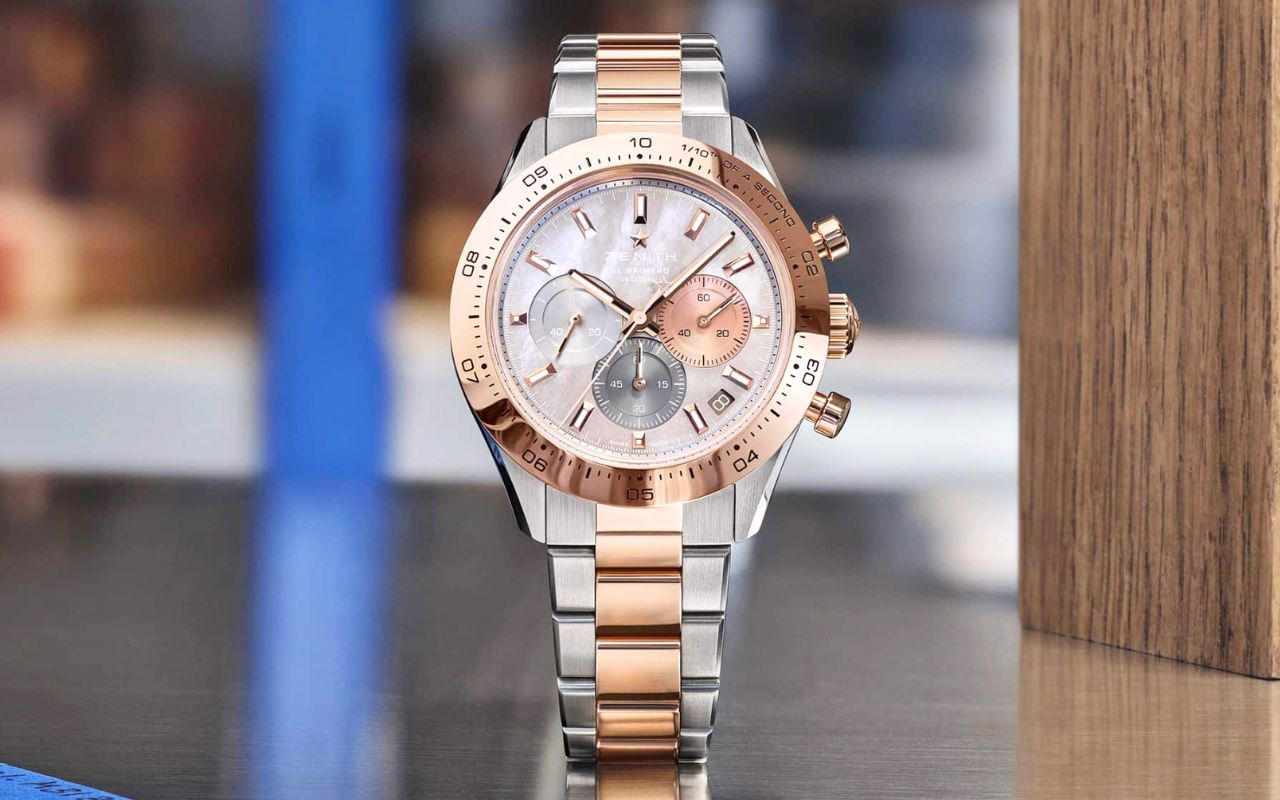
The Zenith Chronomaster Sport didn’t arrive as a nostalgia play. When it launched in 2021, it targeted a very specific gap: a modern, sporty chronograph that still feels unmistakably tied to the brand’s precision-timing DNA.
You see it in the tri-color overlapping subdials, and you feel it in the way the watch wears like a contemporary steel sports piece, not a fragile “heritage” object. What makes it more than “just another chronograph” is the technical promise you can actually notice. The watch’s central chronograph hand doesn’t crawl around the dial in a minute, it rockets around in 10 seconds to display 1/10-second measurements. That single design choice changes the whole personality, and it’s a big reason collectors talk about it like a modern reference, not a trend item.
Zenith launches the Chronomaster Sport in 2021 with a 1/10-second display
From day one, the Chronomaster Sport was positioned as the edgier sibling to the Chronomaster Original, with a case and bezel setup meant for daily wear. Early steel versions paired black or white dials with the brand’s signature tri-color subdials, and the launch configuration leaned into a sporty vibe with a ceramic bezel. If you’re tracking why this model caught on, start here: it was recognizable at a glance, but it also looked current next to the hottest steel chronographs in the market.
The headline feature is the movement’s behavior on the wrist. Thanks to the El Primero 3600, the central chronograph seconds hand completes one lap in 10 seconds, letting the dial show 1/10-second readings without asking you to do mental math. Marc, a collector who rotates between modern chronographs, puts it bluntly: “It’s the rare complication you can demonstrate in two seconds, people instantly get it.” That kind of instant legibility is part engineering, part showmanship.
There’s a nuance worth saying out loud. A 1/10-second display is fun, but it’s not automatically “more useful” for most daily timing, where minutes and seconds do the job. The Chronomaster Sport’s value is that it makes high-frequency timing visible and dramatic, and that’s a different proposition than pure utility. If you want a chronograph that feels alive every time you press the pusher, this is the pitch, and it’s a strong one.
El Primero 3600 adds 60-hour reserve and stop-seconds for daily wear
The Chronomaster Sport’s collectibility is tied to its modernized engine, not just its looks. The El Primero story starts in 1969, and the 3600 generation keeps that lineage while updating it for contemporary expectations. The movement is built with modern manufacturing choices like standardized screw sizes, which sounds boring until you realize it supports long-term serviceability, the unglamorous factor that separates “cool watch” from “keep it for decades.”
Two upgrades matter for anyone who actually wears the watch. First, the power reserve is rated at 60 hours, which means you can take it off Friday night and still have it running Monday morning. Second, there’s a stop-seconds mechanism, letting you set the time precisely. Marc, who’s picky about synchronization, told me, “If a watch is positioned as precision timing, I want it to hack. Otherwise it’s just marketing.” That’s a fair critique, and Zenith addressed it.
Flip the watch over and you also see where Zenith pushed “modern” in a visual way. Under the sapphire caseback, the decoration is updated compared to older El Primero executions, and newer releases introduced a star-shaped oscillating weight. It’s not about shouting luxury, it’s about making the movement feel like a current product, not a museum piece. For collectors, those small generational cues often become the breadcrumbs that define early versus later runs.
Zenith expands editions with steel, gold, and blue ceramic to drive demand
After the 2021 debut, the Chronomaster Sport quickly became a platform for variations. Zenith moved beyond the initial steel-and-ceramic-bezel formula with a gold-on-strap version, then followed with evolutions in 2022 including boutique-focused executions and precious-metal options. That steady cadence matters in the collector ecosystem: it keeps the reference in the conversation, and it gives buyers a reason to choose a specific configuration instead of defaulting to “the first one I saw.”
In 2023, Zenith highlighted full-steel versions with a polished steel bezel and a metallic blue dial, leaning into a cleaner, brighter look than the original ceramic-bezel vibe. There was also a pink-dial steel model tied to a charitable cause, which shows how the brand uses color to create identity without rewriting the core design. If you’re watching long-term desirability, these dial and bezel shifts can become the dividing lines that collectors use later: “pre-blue,” “blue steel,” “ceramic era,” and so on.
The most aggressive material move is the full blue ceramic execution, notable because it’s the first time the Chronomaster Sport used a full ceramic case and bracelet, done in a tone-on-tone “Zenith blue” that carries through to the dial. This also intersects with the inevitable comparison chatter to the Rolex Daytona. The similarity debate is real, but the historical footnote is, too: the Daytona used to be El Primero-powered. That doesn’t settle the argument, but it reframes it, and it helps explain why this Zenith sits comfortably as a modern collectible rather than a copycat story.
To remember
- The Chronomaster Sport debuted in 2021 as a modern, sporty chronograph built around visible high-frequency timing.
- The El Primero 3600 delivers a 1/10-second display with a central hand that laps the dial in 10 seconds, plus a 60-hour reserve and stop-seconds.
- Zenith’s steady flow of steel, gold, and blue ceramic editions helps position the model as a modern collectible line, not a one-off release.
- Comparison talk with the Rolex Daytona persists, but Zenith’s El Primero link to Daytona history complicates the “look-alike” narrative.
Q&A
- What makes the Zenith Chronomaster Sport different from a typical chronograph?
- Its El Primero 3600 is designed to show 1/10-second timing in a way you can see instantly: the central chronograph seconds hand circles the dial in 10 seconds, not 60. That creates a noticeably more dynamic display than most chronographs.
- Is the 1/10-second feature actually useful day to day?
- For many daily tasks, seconds and minutes are enough. The value is more experiential than practical: the fast sweep makes high-frequency timing visible, and it turns starting the chronograph into a tangible, watch-nerd moment rather than a subtle complication.
- What practical upgrades does the El Primero 3600 bring?
- Beyond the 1/10-second display, it offers a 60-hour power reserve and a stop-seconds mechanism for precise time setting. It also reflects modern manufacturing choices intended to support long-term servicing.
- Why do people compare it to the Rolex Daytona?
- The Chronomaster Sport entered the same high-demand steel sports chronograph space, and early dial and bezel cues triggered visual comparisons. The discussion is sharpened by history: the Daytona previously used an El Primero-based movement, which links the two models in collector culture.
