

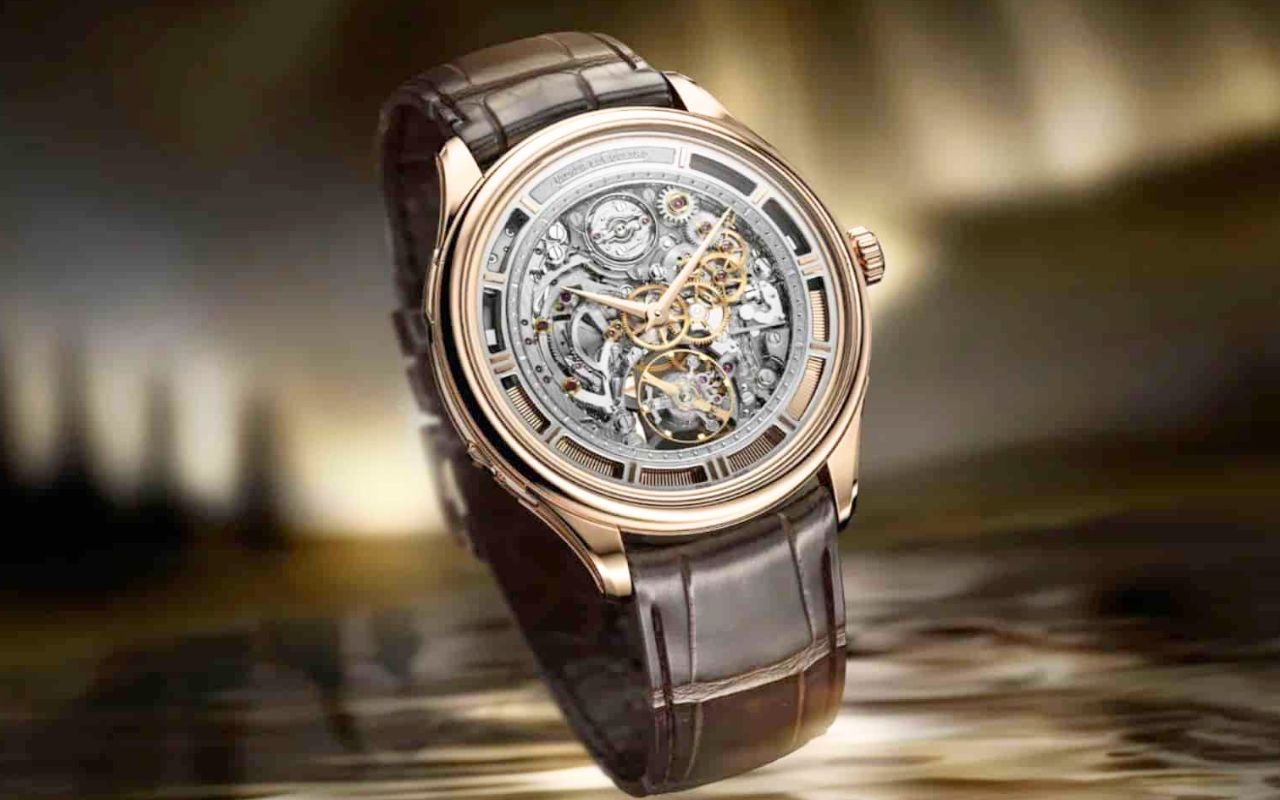
Jaeger-LeCoultre is putting an old record back on the table with the Master Hybris Mechanica Ultra Thin Minute Repeater Tourbillon, a 2026 release built around Calibre 362, described as the world’s thinnest automatic minute repeater with a tourbillon.
The headline numbers are blunt: a movement about 4.7mm thick inside an 8.25mm case, with a limited run of 10 pieces. This is not a “thin watch” story in the abstract. It’s about stacking two of the hardest complications, a minute repeater and a flying tourbillon, and still keeping the watch wearable at roughly 41.4mm to 42mm across depending on how it’s measured. Jaeger-LeCoultre is also leaning into transparency, using sapphire elements and an openworked display that makes the engineering part of the sales pitch.

Calibre 362 fits 537 parts into 4.7mm
Calibre 362 is the core argument: a fully integrated architecture rather than a layered build, designed from the start to combine automatic winding, a minute repeater, and a flying tourbillon without ballooning in height. In the latest iteration, the movement is cited at 537 components and about 4.7mm thick, a packaging exercise where every fraction of a millimeter becomes a design constraint.
One of the most telling details is how the striking works are compressed. The minute repeater mechanism is engineered to occupy roughly one third of the movement’s volume, with racks, hammers, and gongs organized within the mainplate. That choice matters because repeaters often grow “upward” with stacked parts. Here, the goal is to avoid that vertical creep while still delivering clear sound and consistent action.
Automatic winding is handled by a peripheral rotor, a solution that preserves the thin profile because it doesn’t sit on top of the movement like a conventional central rotor. The tourbillon is a flying tourbillon, meaning it’s suspended without an upper bridge, which trims structural height and opens the view. Put together, it’s a coherent strategy: reduce layers, reduce bridges, and keep the complications from fighting each other for space.
Rose-gold case stays at 8.25mm, limited to 10
The watch is housed in an 18k rose gold case that stays at 8.25mm thick, with a diameter reported around 41.4mm to 42mm. Those dimensions matter because minute repeaters and tourbillons often end up as “special occasion” pieces that feel bulky. Here, the sizing reads closer to a modern dress watch, even if the visual presence is anything but understated.
The display is aggressively openworked, and Jaeger-LeCoultre goes beyond standard skeletonization by using sapphire bridges so the movement feels almost floating. That decision is as much about communication as aesthetics: you can see the layout choices that make the thinness possible. A practical complication follows, setting jewels into sapphire is not straightforward, so the brand uses gold chatons for ruby settings in key places.
There’s also a market reality baked in. This is a 10-piece limited edition, with price listed as “on request,” which signals scarcity and a buyer pool that already understands what a minute repeater represents. If you want a critical note, it’s that transparency can become a distraction: some collectors still prefer a calmer dial that lets the sound and finishing do the talking. Jaeger-LeCoultre is betting that, in 2026, visible engineering is part of the value proposition.
Minute repeater sound and reliability drive seven patented solutions
Jaeger-LeCoultre frames thinness as a balancing act, not an end in itself. The brand points to the risk that ultra-slim constructions can become sensitive to distortion, where minor flex can stop a movement. The message is direct: the objective is wearability and dependability, even in a watch that’s trying to hold a “world’s thinnest” claim in a category where tolerances are unforgiving.
The technical narrative includes seven patents tied to the Calibre 362 project, with six originating from the movement’s earlier development. Those patents cover the kind of behind-the-scenes solutions that make a minute repeater viable in a thin, automatic format. The watch also uses articulated trebuchet hammers, designed to strike the gongs with higher velocity and precision, a detail that speaks to acoustic performance rather than just miniaturization.
Power reserve is listed at about 42 hours, a figure that feels realistic for a movement prioritizing compactness and a complex striking system. In the current landscape, brands like Bulgari have pushed ultra-thin watchmaking hard, but the specific combination of automatic winding, minute repeater, and tourbillon remains rare at this thickness. The implication is that Jaeger-LeCoultre is defending a niche where engineering, sound, and packaging all have to land at once, with no obvious place to hide mistakes.
To remember
- Calibre 362 combines an automatic minute repeater and flying tourbillon in about 4.7mm thickness.
- The 2026 model uses an 8.25mm rose-gold case and is limited to 10 pieces.
- A peripheral rotor and sapphire bridges help preserve thinness while showcasing the movement.
- Jaeger-LeCoultre emphasizes reliability and acoustic performance, backed by seven patents.
Q&A
- What makes Calibre 362 notable in ultra-thin watchmaking?
- Calibre 362 is notable for integrating automatic winding, a minute repeater, and a flying tourbillon in an exceptionally slim architecture, with the movement cited around 4.7mm thick. The layout prioritizes integration over stacked modules, using solutions like a peripheral rotor and a flying tourbillon to control height.
- How thin is the Master Hybris Mechanica Ultra Thin Minute Repeater Tourbillon?
- The movement is reported at about 4.7mm thick, while the complete watch is housed in a case about 8.25mm thick. The diameter is reported around 41.4mm to 42mm depending on measurement, keeping the piece relatively wearable for its complication level.
- Why does Jaeger-LeCoultre use a peripheral rotor here?
- A peripheral rotor winds the watch without adding the vertical height of a traditional central rotor mounted above the movement. In an ultra-thin minute repeater and tourbillon design, preserving height is critical, so peripheral winding supports the thin profile while maintaining automatic functionality.
- Is this 2026 watch a mass-market release?
- No. It is a limited edition of 10 pieces, with pricing listed as on request. That positioning reflects the complexity of the minute repeater and tourbillon combination, the specialized manufacturing involved, and the collector-focused nature of such high-complication watches.
Sources
- Introducing: Jaeger-LeCoultre Jaeger-LeCoultre Master Hybris Mechanica Ultra Thin Minute Repeater Tourbillon
- Jaeger-LeCoultre Master Hybris Mechanica Ultra Thin Minute Repeater Tourbillon – The Watch Pages
- Introducing: Jaeger-LeCoultre’s Master Hybris Inventiva Gyrotourbillon À Stratosphère, Master Hybris Mechanica Ultra Thin Minute Repeater, And Master Grande Tradition Tourbillon Jumping Date – Hodinkee
- Jaeger-LeCoultre Master Ultra-Thin Minute Repeater Flying Tourbillon Hybris Mechanica 11 Hands-On | aBlogtoWatch
- Melody Unveiled: the Master Hybris Mechanica Ultra Thin Minute Repeater Tourbillon | Worldtempus
