

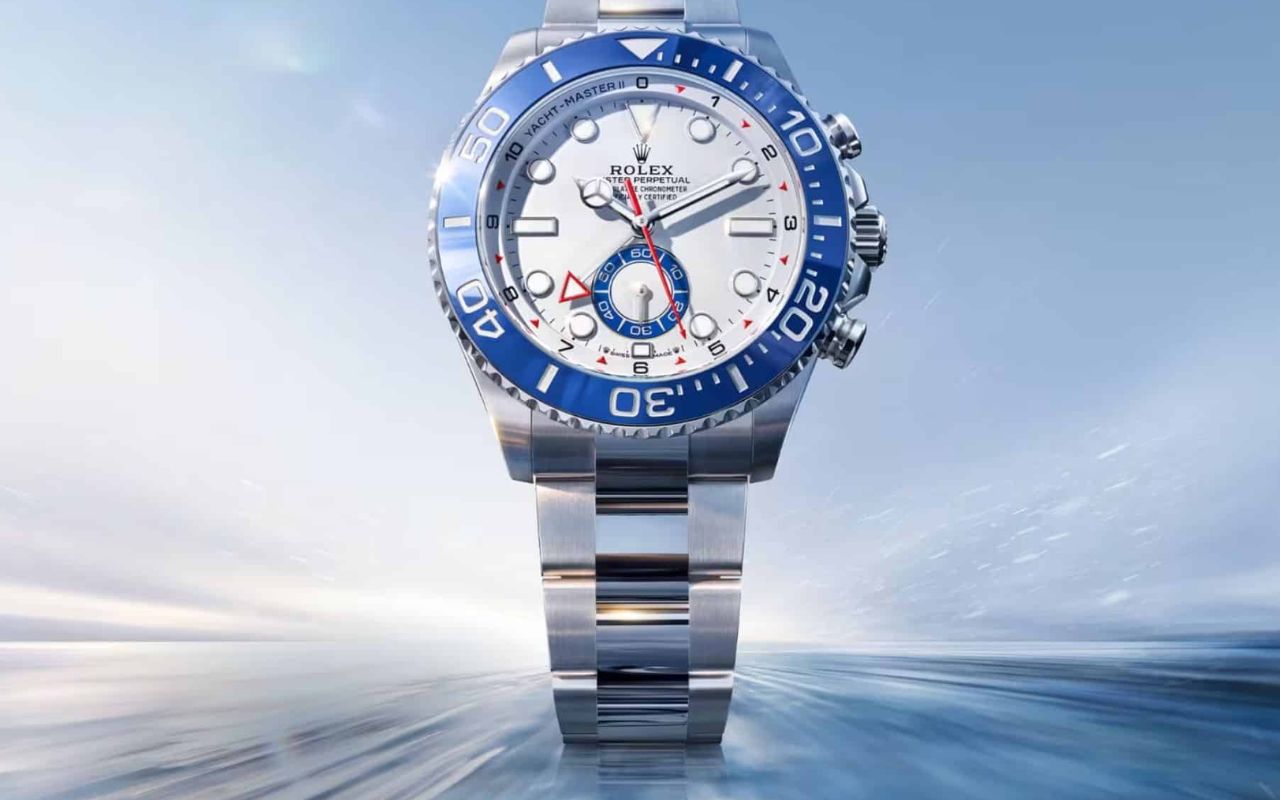
Rolex positions the Yacht-Master II as a purpose-built tool watch for regatta starts, a moment where just a few seconds can decide a race.
Recognizable by its 44 mm case and technical bezel, the model highlights a programmable countdown, enhanced legibility, and a movement designed to withstand the constraints of a marine environment. In 2026, the watch continues to occupy a unique segment, the regatta chronograph, with versions in Oystersteel and 18 ct yellow gold, combining real on-water functionality with strong wrist presence.
Rolex integrates a programmable countdown for race starts
A regatta start is not just about accelerating quickly. The pre-start phase follows an official sequence, often 10 minutes or 5 minutes depending on the class, during which crews aim to cross the line at full speed exactly when the countdown reaches zero. Being one second early can mean a penalty, while one second late can trap a boat in disturbed wind. The Yacht-Master II was designed specifically for this scenario, featuring a dedicated regatta countdown rather than a general-purpose chronograph.
The system is based on programming the countdown, then synchronizing it with the official signal. If the sequence is 5 minutes, the wearer sets the duration, starts the countdown, and can adjust it if there is a mismatch with race committee signals. This reflects real conditions on the water, where starts can be recalled or sequences adjusted. The goal remains the same, aligning the final maneuver perfectly with zero.
The watch relies on an interaction between bezel and movement, a key part of its identity. The Ring Command bezel is not just aesthetic. It actively participates in setting and controlling the countdown functions. This mechanical integration reduces handling errors, especially with wet hands or under pressure when attention is divided between steering, sails, and competitors.
In practice, this tool makes sense when observing a dense fleet before the start. Boats accelerate, slow down, cross paths, and search for positioning. In tightly matched fleets, the difference lies in timing and placement. The regatta function of the Yacht-Master II fits this reality, delivering time information that is directly usable without mental conversion and readable at a glance.

The white lacquer dial enhances legibility in marine conditions
Legibility is more complex than it appears, especially in a marine environment filled with reflections, spray, movement, and rapidly changing light. On the Yacht-Master II, Rolex highlights a white lacquer dial, chosen for its clarity and ability to create strong contrast with markers and hands. On deck, a watch is rarely read at rest. It is checked in motion, often while adjusting sails or monitoring competitors.
Color details support instant readability. Depending on the reference, hands feature accents that highlight essential information. On the 126680, touches of red lacquer emphasize regatta chronograph elements. On the 126688, the use of yellow gold for certain details creates a different visual hierarchy, more luxurious but still structured around functionality. The goal is to quickly identify the countdown phase without focusing too long on the dial.
The 44 mm size also plays a role. A larger watch offers more surface for clear markings and longer hands, reducing ambiguity. While sometimes considered oversized in urban use, this dimension makes sense on a boat, where equipment must remain readable despite vibration and distance. The bezel scale and countdown indications are designed for immediate understanding.
In practice, readability is measured under constraint. During a 5-minute pre-start, crews often execute multiple maneuvers to position themselves. Checking the watch must take less than a second. The combination of contrast, markings, and size aims to achieve this, prioritizing function while maintaining a refined lacquer finish.
The caliber 4162 structures regatta functionality and reliability
At the core of the model, the movement is central to the technical narrative. The Yacht-Master II is powered by the caliber 4162, an automatic movement designed to handle a programmable regatta countdown chronograph. Its value lies not only in time measurement but in how the complication is integrated, with a control system designed to minimize unnecessary manipulation and ensure long-term reliability.
In a regatta watch, the countdown is not just a timer. It must allow setup, start, and synchronization with official signals while remaining consistent with chronograph display. This coherence is crucial during tense starts, when the boat accelerates and decisions must be made within seconds. The movement is designed to deliver stable mechanical response, with no hand hesitation and quick resynchronization when needed.
Durability is also key. A watch worn at sea faces shocks, temperature changes, humidity, and repeated impacts. The movement must withstand these conditions without significant deviation. Within the Rolex universe, reliability is built on proven architecture and strict internal standards. For the user, this translates into consistent performance even under demanding conditions.
The movement also supports the product’s economic positioning. In the luxury sport watch market, perceived value depends on the combination of design, complication, and reliability reputation. The regatta complication, rarer than a traditional chronograph, sets the Yacht-Master II apart in a catalog where most models serve broader uses. This specialization narrows the audience but strengthens identity.

Oystersteel and 18 ct yellow gold address two distinct uses
Rolex offers the Yacht-Master II in configurations that clearly shape its perception. The Oystersteel version aligns with a sport-oriented approach, using a material known for corrosion resistance, essential in saltwater environments. For owners who wear the watch while sailing, steel is often the rational choice. More discreet, versatile, and less prone to visible wear than highly polished surfaces.
The 18 ct yellow gold version reflects a different expectation. It retains the technical DNA of the regatta chronograph but shifts toward a more status-driven presence. In marinas and events, the watch becomes a statement object. This duality is common in luxury sport watchmaking. The same architecture can serve functional or social purposes depending on material and finishing. On a 44 mm watch, yellow gold enhances visual impact.
The three-link bracelet, combining brushed and polished finishes, reinforces this positioning. Brushed surfaces reduce visible wear, while polished elements add shine, especially in gold. Comfort is critical, as a large and heavy watch can become uncomfortable if poorly balanced. Owners expect a secure fit that stays stable during active use.
The water resistance remains essential. Rated at 100 meters, it supports realistic use cases such as spray, rain, and occasional immersion without positioning the watch as a diving instrument. For a sailing watch, this level is consistent, as the main risk comes from repeated exposure rather than deep diving.
Rolex strengthens its link with TP52 regattas and competitive sailing
The legitimacy of a regatta watch extends beyond the product itself. Rolex maintains a long-standing connection with sailing, often described as over 60 years of involvement in yachting. This connection is reflected in partnerships with high-level competitions where start precision is critical. In fleets like the TP52, boats are closely matched, making the pre-start phase a contest of positioning and timing.
A typical race sequence illustrates this reality. During a 5-minute start, some boats cross early and return, while others stay close to control competitors. The objective is to cross the line at full speed exactly at zero. In this context, a readable and synchronizable countdown becomes a decision-making tool, even if strategy remains in the hands of the skipper and tactician.
The watch also becomes a symbol of belonging to this world. International events feature crews of former Olympians and elite sailors, reinforcing the technical image. Associating the Yacht-Master II with this level of competition justifies its specialized function.
This connection influences perception in boutiques and on the secondary market. Watches with a clearly defined use case stand out in a landscape where many sport models are worn mainly as style objects. The Yacht-Master II remains polarizing due to its size and design, but its functional coherence makes it appealing to those seeking a distinctive watch tied to a specific sport rather than a generic luxury variation.
